

 Air Conditioner Scrap
 Battery Scrap
 ELECTRICAL MOTORS SCRAP
 ELECTRICAL WIRE SCRAP
 CLEAN LEAD SCRAP METAL
 BRASS SCRAP METAL
 COPPER SCRAP METAL
 STAINLESS STEEL SCRAP
 ALUMINIUM SCRAP
 SCRAP METAL RECYCLING
 SCRAP METAL REMOVAL
 CAR YARDS
 CAR REMOVAL
 VEHICLE DISPOSAL
 MONEY FOR CAR REMOVAL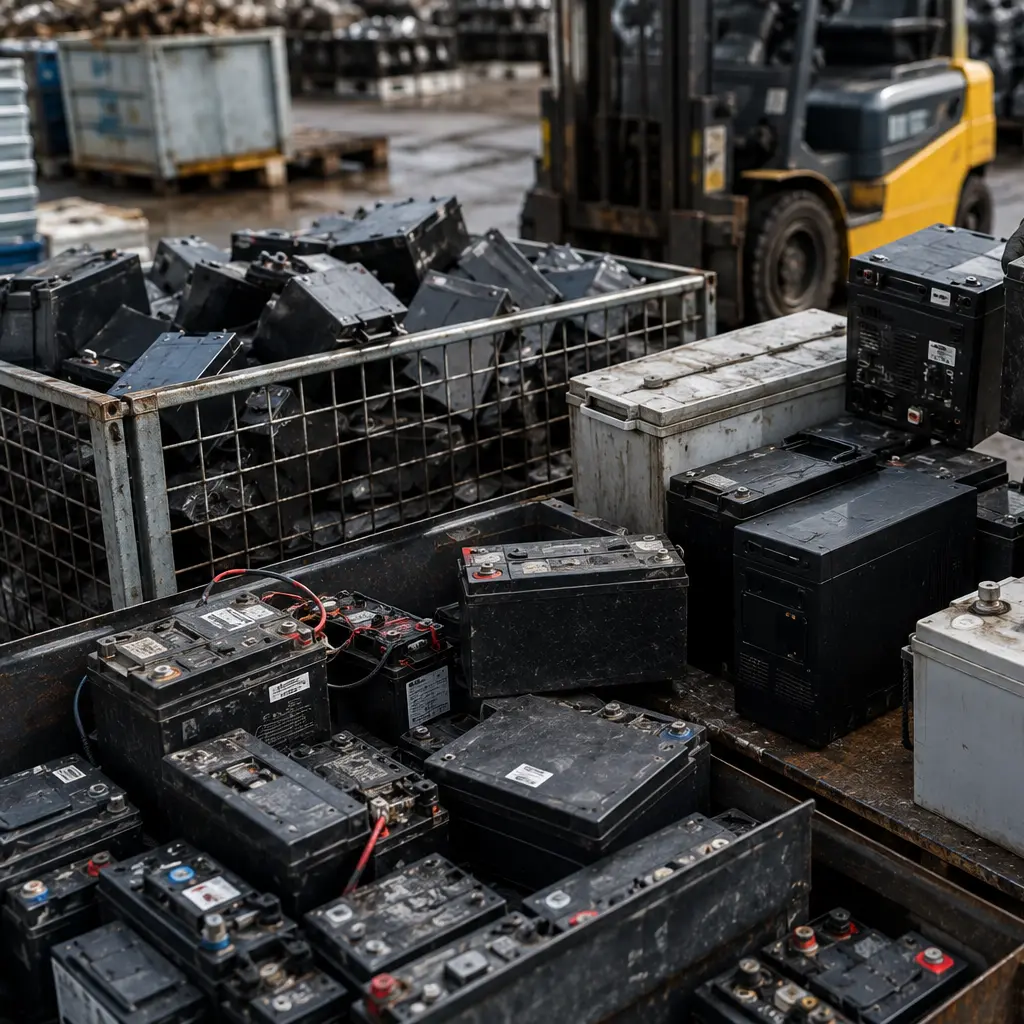
Most people in Melbourne know that old car batteries have scrap value. Far fewer people realise that the same principle applies to a much broader range of batteries: the UPS units running in every server room and data centre, the sealed lead-acid batteries backing up security systems and emergency lighting across commercial buildings, the large gel cell packs in telecommunications infrastructure, and the massive flooded lead-acid traction batteries powering industrial forklifts.
All of these battery types contain lead. Lead is a recyclable commodity metal with a well-established secondary market, and the scrap value of lead-acid batteries of all types is real and consistent. The battery recycling industry is one of the most mature closed-loop recycling systems in the world: the lead recovered from old batteries is reprocessed and used to manufacture new batteries, creating a cycle that has operated at scale for decades.
This guide focuses specifically on non-automotive batteries: UPS batteries, sealed lead-acid (SLA) units, valve-regulated lead-acid (VRLA) gel cell and AGM batteries, large-format flooded batteries, and industrial traction batteries. If you are looking for information on car and truck battery scrap pricing, that topic is covered separately in our guide on car battery scrap prices in Melbourne.
What follows covers why these batteries have scrap value, what each type is worth, who is most likely to accumulate them, the Victorian regulations around battery disposal, how to handle and transport them safely, and how to sell or arrange collection through Sky Scrap Metal.
Why Lead-Acid Batteries Have Scrap Value
The scrap value in lead-acid batteries comes from their chemistry. In a standard lead-acid battery, the positive electrode plates are made from lead dioxide, the negative electrode plates are made from sponge lead, and the electrolyte is a dilute sulphuric acid solution. Together, these components represent a significant weight of lead in a predictable, recoverable form.
Lead has been recycled from batteries since the early twentieth century, and today battery recycling accounts for the vast majority of global secondary lead production. The process is well-established: the battery is broken apart in a licensed facility, the lead plates and lead dioxide are separated and smelted into recycled lead ingots, the polypropylene casing is chipped and recycled, and the sulphuric acid electrolyte is either reclaimed for reuse or neutralised.
The price paid for scrap batteries is based on the lead content and the current lead commodity price as traded on the London Metal Exchange (LME). Lead pricing is generally less volatile than copper or nickel, which makes battery scrap pricing relatively predictable from month to month, though it does move with global supply and demand conditions.
Beyond lead, batteries also contain polypropylene casing, copper terminal connections, and in some designs, antimony, calcium, or tin alloys used to harden the lead plates. These contribute to the overall recyclable content of the battery but lead remains the dominant value driver.
Victorian Regulations on Battery Disposal
In Victoria, batteries are classified as hazardous waste under the Environment Protection Act 2017 (EPA Victoria) because they contain lead (a heavy metal) and sulphuric acid (a corrosive substance). This classification means they cannot legally be disposed of through general waste streams, landfill, or unsorted commercial waste bins.
The Battery Stewardship Council Australia (B-cycle) operates the national battery recycling programme and provides guidance on the obligations of both consumers and businesses when disposing of batteries. Commercial and industrial operators in Victoria who generate battery waste are required to ensure it is directed to licensed recycling facilities. Sky Scrap Metal’s Dandenong facility is a licensed destination for lead-acid battery scrap.
Practically speaking, this means that if your business accumulates UPS batteries, gel cell units, or industrial traction batteries during normal operations, you cannot simply place them in the skip or arrange general waste removal. They need to be handed to a licensed battery recycler or scrap metal dealer who will process them through the appropriate channel. Sky Scrap Metal handles this and pays you for the material rather than charging you for disposal.
Types of Batteries Sky Scrap Metal Buys in Melbourne
Sealed Lead-Acid (SLA) Batteries
Sealed lead-acid batteries, also called VRLA (valve-regulated lead-acid) batteries, are the most common type of backup power battery in commercial buildings. They are completely sealed, maintenance-free, and designed to operate in any orientation. The term sealed lead-acid covers both the gel cell and AGM subtypes described below, but in casual usage it often refers to the small rectangular batteries used in UPS units, security systems, and emergency lighting equipment.
SLA batteries are typically 6 volt or 12 volt units ranging from 1 ampere-hour to around 100 ampere-hours in capacity. They are used in enormous quantities across Melbourne’s commercial and industrial building stock, and they have a service life of three to five years before they require replacement. This creates a constant and predictable stream of scrap SLA batteries from the building maintenance sector.
VRLA Gel Cell Batteries
Gel cell batteries are a subtype of VRLA battery in which the electrolyte is immobilised in a silica gel matrix rather than being free liquid. This construction makes them particularly resistant to vibration and suitable for applications where the battery may be tilted or inverted. Gel cell batteries are widely used in telecommunications backup power systems, medical equipment, and some industrial UPS applications.
From a scrap perspective, gel cell batteries are valued the same way as other lead-acid batteries: by weight and lead content. The gel electrolyte does not affect the lead recovery process at a licensed recycling facility.
AGM (Absorbed Glass Mat) Batteries
AGM batteries are another VRLA subtype in which the electrolyte is absorbed into glass fibre mat separators between the plates. AGM technology provides a higher power density than gel cell and better cycle performance, making it the preferred choice for premium UPS systems, solar battery banks, marine and RV deep-cycle applications, and some telecommunications infrastructure.
AGM batteries are typically heavier for their physical size than gel cell units of equivalent capacity, which means they contain more lead per unit. In high-capacity AGM format, they can be quite heavy and valuable as scrap. Large AGM battery banks from data centres and solar installations can represent significant scrap value.
Large-Format Flooded Lead-Acid Batteries
Flooded lead-acid batteries are the traditional design in which the electrolyte is free liquid sulphuric acid surrounding the electrode plates in a vented container. While flooded batteries require periodic maintenance (checking electrolyte levels and adding distilled water), they are extremely robust and are used in applications requiring high cycle life and large energy storage capacity.
In Melbourne, flooded lead-acid batteries appear primarily in industrial traction applications: forklifts, reach stackers, order pickers, and other electric industrial vehicles. They are also used in large stationary backup power applications such as standby power for telephone exchanges and some utility installations.
Forklift batteries in particular are extremely valuable as scrap. A single 48-volt forklift battery pack consists of a series of individual flooded cells assembled in a steel tray, and the entire assembly can weigh from 500 kilograms to well over a tonne. The lead content in a large forklift battery is substantial and represents some of the most valuable individual scrap items that a recycler handles.
Nickel-Cadmium (NiCd) Batteries
Nickel-cadmium batteries were widely used in industrial and emergency applications before being largely superseded by newer technologies. They appear in older emergency lighting systems, industrial power tools, and some aviation applications. NiCd batteries do not contain lead but they do contain cadmium, which is a toxic heavy metal requiring careful handling and licensed recycling. Contact Sky Scrap Metal for specific advice on NiCd batteries as their processing pathway differs from lead-acid.
Lithium-Ion Batteries (Commercial and Industrial)
Commercial lithium-ion battery packs from data centre UPS systems, commercial solar battery banks, and industrial energy storage applications are increasingly appearing in the scrap stream as the technology ages. Lithium-ion batteries require specialised handling and cannot be processed through the same pathway as lead-acid batteries. Sky Scrap Metal can advise on the appropriate recycling pathway for commercial lithium-ion battery packs. Do not transport damaged or swollen lithium-ion batteries without taking appropriate precautions.
Battery Type | Chemistry | Primary Scrap Value | Common Voltage / Size | Common Sources |
Sealed lead-acid (SLA) | Lead-acid | Lead content | 6V or 12V, 1-100 Ah | UPS, alarms, emergency lighting |
VRLA gel cell | Lead-acid (gel) | Lead content | 6V or 12V, up to 200 Ah | Telecom backup, medical, UPS |
AGM | Lead-acid (AGM) | Lead content, higher density | 12V, up to 300+ Ah | Premium UPS, solar, marine |
Flooded traction (forklift) | Lead-acid | Very high lead mass | 24V to 80V, 300-1500+ kg | Forklifts, electric vehicles, order pickers |
Flooded stationary | Lead-acid | High lead mass | 2V cells in strings | Exchange backup, utility standby |
Nickel-cadmium (NiCd) | Nickel-cadmium | Nickel and cadmium | Various | Industrial tools, emergency lighting |
Lithium-ion (commercial) | Lithium | Lithium compounds | 48V to 800V packs | Data centre UPS, commercial solar |
What Determines the Scrap Value of Your Batteries?
Battery scrap pricing is more straightforward than many other metals categories because lead-acid batteries have a predictable and consistent lead content relative to their weight. The main variables are:
Weight and Lead Content
Heavier batteries contain more lead and are worth more in absolute dollar terms. Lead-acid batteries are heavy for their size: a standard 12-volt 100 Ah SLA battery weighs approximately 25 to 30 kilograms, with lead making up roughly 60 to 65 per cent of that weight. The lead content ratio is fairly consistent across most lead-acid designs, which makes weight a reliable proxy for value.
Current Lead Commodity Price
The price of lead on the London Metal Exchange moves with global supply and demand conditions. Lead pricing is generally less volatile than copper or nickel, but it does shift over weeks and months. Sky Scrap Metal pays the current market rate assessed on the day of each transaction.
Battery Integrity
Intact batteries in good physical condition are preferred. Cracked or leaking batteries require additional handling precautions because the sulphuric acid electrolyte is corrosive. Leaking batteries are still accepted but may be assessed slightly more conservatively to account for the handling requirement. Completely shattered or heavily fragmented batteries are handled on a case-by-case basis.
Volume
As with all scrap categories, volume improves the per-kilogram rate. A single UPS battery brought in on its own will be assessed at standard rates. A pallet of fifty batteries from an IT refresh, or a forklift battery from an industrial operation, will typically attract better commercial pricing. Businesses that generate regular battery scrap benefit from establishing a scheduled collection arrangement.
Battery Type and Sorting
Mixed loads of different battery types can be assessed together, but if you have batteries with known higher lead content or specific characteristics, presenting them separately may improve your return. Forklift batteries and large-format flooded cells should always be assessed individually rather than lumped in with small SLA units.
Scrap Battery Prices in Melbourne: What to Expect
Battery Category | Typical Weight Range | Lead Content | Indicative Value Notes |
Small SLA (up to 12 Ah) | 1 to 4 kg each | High proportion by weight | Best sold in volume batches |
Medium SLA (12 to 100 Ah) | 4 to 30 kg each | High proportion by weight | Individual units have solid value |
Large AGM (100 Ah+) | 30 to 60 kg each | High proportion by weight | Good per-unit return |
Telecom VRLA battery strings | 50 to 500 kg total | High proportion by weight | Excellent commercial volume value |
Small forklift battery (24V to 36V) | 300 to 600 kg | Very high mass of lead | High individual value, assess separately |
Large forklift battery (48V to 80V) | 600 kg to 1.5 t | Very high mass of lead | Very high value, site collection recommended |
Stationary flooded cells (exchange) | 100 kg to several t | Very high mass of lead | Contact for individual assessment |
Price Disclaimer: Battery scrap prices are based on the lead commodity price as quoted on the London Metal Exchange (LME) lead contract. Lead prices fluctuate with global supply and demand conditions. All prices paid by Sky Scrap Metal reflect current market rates at the time of each transaction and are subject to change without notice. The indicative value notes above do not constitute a quote. Contact Sky Scrap Metal directly with battery type and volume for a current price indication. |
For broader context on how scrap metal pricing is determined across all metal types, see our guide on factors influencing scrap metal prices in Australia.
Who Accumulates Non-Automotive Battery Scrap in Melbourne?
IT Departments and Data Centre Operators
Data centres, server rooms, and IT infrastructure environments depend on UPS (uninterruptible power supply) systems to maintain power to critical equipment during grid outages. UPS systems contain banks of sealed lead-acid batteries, typically 12-volt units of 7 Ah, 9 Ah, or higher capacity, arranged in string configurations. The service life of UPS batteries is typically three to five years, after which they must be replaced to maintain reliable backup power.
A single server room UPS cabinet might contain anywhere from four to thirty-two individual batteries. A large data centre running hundreds of UPS units replaces substantial volumes of batteries on an ongoing rolling programme. IT refresh projects, UPS system upgrades, and data centre consolidations can generate large single-event battery volumes. These are some of the most consistent and predictable sources of SLA battery scrap in Melbourne.
Facilities Managers and Building Engineers
Commercial and industrial buildings across Melbourne are fitted with safety and security systems that all rely on battery backup: fire detection panels, access control systems, security alarm panels, intercoms, emergency lighting circuits, and exit sign luminaires. All of these use sealed lead-acid batteries that require periodic replacement. A large office building or industrial complex can have dozens to hundreds of individual backup batteries spread across its systems.
Facilities managers who replace these batteries systematically accumulate meaningful scrap volumes. Rather than disposing of them through general waste (which is not legally permissible in Victoria), selling them to Sky Scrap Metal turns a waste management obligation into a cash return. For information on how to arrange a convenient collection, see our guide on free scrap metal pick-up in Melbourne.
Electrical Contractors and Security System Installers
Electricians and security system technicians who service commercial buildings are a front-line source of scrap SLA batteries. Every service call to replace a failed UPS battery, a flat emergency lighting battery, or a dead security panel backup generates battery scrap. An active commercial electrician or security installer can accumulate a useful volume of batteries every few weeks.
Telecommunications Contractors
Melbourne’s telecommunications infrastructure, including mobile tower sites, exchanges, and distribution points, relies heavily on battery backup systems. These installations use large VRLA battery strings typically configured at 48 volts DC and sized to provide hours of runtime during a power outage. Battery replacement on telecom sites is a specialist maintenance activity, and the removed batteries represent significant weight of high-grade lead-acid scrap.
Forklift Fleet Operators and Material Handling Companies
Electric forklifts, order pickers, pallet movers, and reach stackers all use large-format flooded lead-acid traction batteries. These batteries are designed for daily deep-cycle use and have a service life of five to eight years with proper maintenance. When a forklift battery reaches end of life, it is one of the most valuable individual scrap items available in the industrial sector.
Forklift fleet operators, third-party maintenance contractors, and battery reconditioning businesses all generate end-of-life forklift battery scrap. Given the weight and hazardous nature of flooded traction batteries, site collection is usually the preferred option rather than attempting to transport them.
Solar and Off-Grid Energy Operators
Victoria’s growing solar and off-grid energy sector has created a new stream of battery scrap as older lead-acid solar storage systems reach end of life or are replaced with lithium alternatives. Commercial solar installations, off-grid farm and rural properties, and remote communications sites all use or have used lead-acid battery banks. The transition to lithium storage is generating a wave of lead-acid battery replacement that will continue over the coming years.
Medical and Emergency Services Equipment
Hospitals, medical clinics, diagnostic equipment suppliers, and emergency services organisations use sealed lead-acid batteries in medical power supplies, portable diagnostic equipment, and emergency response systems. These batteries are replaced on strict maintenance schedules and represent a consistent scrap source from the healthcare sector.
How to Handle and Transport Scrap Batteries Safely
Lead-acid batteries contain sulphuric acid electrolyte, which is corrosive to skin, eyes, and clothing, and they release hydrogen gas during charging and discharging cycles. Safe handling practices protect both people and property.
General Safe Handling Guidelines
- Keep batteries upright at all times to prevent electrolyte leakage from flooded and gel cell types. Sealed AGM and gel batteries can typically be placed on their sides but manufacturer guidance should be confirmed.
- Cover or tape terminal connections before storing or transporting batteries. Exposed positive and negative terminals that come into contact with metal objects or other batteries can short-circuit, generating dangerous heat and potentially causing fire.
- Use personal protective equipment. When handling batteries manually, wear nitrile gloves and safety glasses as a minimum. If handling cracked or leaking batteries, add an acid-resistant apron.
- Ensure good ventilation during transport. Lead-acid batteries can vent small amounts of hydrogen gas. Transporting large quantities in a fully enclosed vehicle without ventilation creates a risk of hydrogen accumulation. Sealed VRLA batteries vent less than flooded batteries but ventilation is still recommended for large quantities.
- Do not stack batteries more than two or three deep to prevent casing damage from compression, which can cause electrolyte leakage.
- Contain leaking batteries immediately. If a battery is cracked or leaking, place it in a plastic tray or chemical-resistant container to contain the electrolyte. Inform Sky Scrap Metal at the time of booking or arrival so the team can handle it appropriately.
Transporting Forklift and Large-Format Batteries
Large flooded traction batteries require specific transport considerations beyond the above. They are extremely heavy and must be moved using appropriate mechanical lifting equipment: a pallet jack, forklift, or crane sling rated for the battery weight. Attempting to move a 600-kilogram forklift battery manually is dangerous. The steel tray holding the cells must be in good condition before transport.
For forklift batteries and large stationary battery banks, Sky Scrap Metal strongly recommends arranging a site collection rather than attempting to transport them. Our team has the equipment and experience to safely assess, load, and transport large battery systems from your site.
How to Sell Scrap Batteries at Sky Scrap Metal
Drop-Off at Our Dandenong Facility
Drop-off is available during business hours for individuals, tradespeople, and businesses with batteries they can safely transport. Drive in, unload, and we weigh and pay on the spot. For mixed loads of different battery types, we assess each category and apply the appropriate rate. Same-day payment for all drop-off transactions.
Scheduled Commercial Collection
For businesses that replace batteries regularly, such as facilities management companies, IT departments, telecommunications contractors, and electrical businesses, a scheduled collection arrangement is more efficient than individual drop-off trips. Sky Scrap Metal can establish a regular pick-up schedule aligned to your maintenance programme, removing the logistics of storing and transporting batteries from your operation.
Site Collection for Forklift and Large-Format Batteries
Forklift batteries and large stationary battery banks should be collected from site rather than transported by the seller. Contact Sky Scrap Metal with details of the battery type, voltage configuration, approximate weight, and site location. We will provide an assessment and arrange a collection that suits your operational schedule.
Why Battery Recycling Matters
Lead-acid batteries have one of the highest recycling rates of any product category in the world. In developed markets including Australia, the recycling rate for lead-acid batteries consistently exceeds 95 per cent, making it one of the most effective closed-loop recycling systems that exists. This high rate is driven by the combination of commercial value (lead is worth recovering) and regulatory requirement (batteries cannot go to landfill).
The environmental case for recycling is compelling. Lead is a persistent heavy metal that accumulates in soil and groundwater and is toxic to humans and wildlife at low concentrations. A single flooded lead-acid battery contains enough lead and sulphuric acid to contaminate a significant volume of soil if landfilled. Proper recycling recovers the lead for reuse and manages the acid safely, preventing that contamination entirely.
The energy savings from recycling lead are also meaningful. Secondary lead production from recycled batteries requires approximately 35 to 40 per cent less energy than producing primary lead from mined ore. Recycling also avoids the mining waste, tailings, and smelter emissions associated with primary lead production. Every battery that reaches a legitimate recycler rather than landfill is a genuine environmental benefit.
Frequently Asked Questions About Scrap Battery Prices in Melbourne
Question | Answer |
What types of batteries does Sky Scrap Metal buy? | Sky Scrap Metal buys sealed lead-acid (SLA) batteries, VRLA gel cell batteries, AGM batteries, large-format flooded lead-acid batteries including forklift traction batteries, and stationary backup power batteries. Contact us regarding nickel-cadmium and lithium-ion batteries as these follow different processing pathways. |
Is there a minimum quantity of batteries required? | There is no minimum for drop-off. A single battery is accepted. Pricing per kilogram does improve with volume, and businesses generating regular battery scrap benefit from a scheduled collection arrangement rather than individual drop-off trips. |
Can I get cash for UPS batteries from an IT room refresh? | Yes. UPS batteries are one of the most common non-automotive battery types we receive and we pay cash on the day of drop-off or collection. Bring them in during business hours or contact us to arrange a pick-up from your premises. |
Are forklift batteries worth a lot as scrap? | Yes. Forklift traction batteries are very heavy and contain a high proportion of lead by weight, making them among the most valuable individual battery scrap items available. A large 48-volt forklift battery can weigh 800 kilograms or more. Contact Sky Scrap Metal for a site collection and individual assessment. |
What do I do with batteries that are cracked or leaking? | Place them in a plastic tray or container to contain the electrolyte and let us know at the time of booking or arrival. Sky Scrap Metal has the equipment and procedures to handle damaged batteries safely. Do not attempt to pour out or dilute the electrolyte yourself. |
Can I dispose of batteries in a general waste skip in Victoria? | No. Lead-acid batteries are classified as hazardous waste under Victoria’s Environment Protection Act 2017 and cannot be disposed of through general waste streams, landfill, or unsorted commercial waste. Sky Scrap Metal is a licensed destination for battery scrap and we pay you for the material rather than charging a disposal fee. |
How much is a forklift battery worth as scrap? | The value depends on the battery’s weight and the current lead price. Contact Sky Scrap Metal with details of your forklift battery including the voltage, cell configuration if known, and approximate weight or forklift model. We will provide a current price indication before arranging collection. |
Do you collect from commercial premises? | Yes. Sky Scrap Metal offers collection from commercial and industrial premises for battery loads that are too heavy to transport easily, or for businesses that prefer not to manage the transport logistics. Contact us to discuss scheduling. |
How does lead pricing affect what I receive for my batteries? | Battery scrap pricing is linked directly to the lead spot price on the London Metal Exchange. Lead is generally less volatile than copper or nickel but it does move with global supply and demand. Sky Scrap Metal pays the current market rate at the time of your transaction. Checking in with us around the time of a planned sell can help you understand current conditions. |
Can I mix different battery types in the same load? | Yes. Mixed loads of SLA, gel cell, and AGM batteries are accepted together. Large-format flooded batteries and forklift units are better assessed separately due to their size and weight. If you have a genuinely mixed load, describe it to us at the time of booking and we will advise on the best way to present it. |
Do you accept batteries with the terminal connections still attached? | Yes. Cables and terminal connections can be left on the batteries. If the cable is copper rather than aluminium, it adds a small amount of copper scrap value to the load. You do not need to cut anything off before bringing the batteries in. |
What happens to the batteries after you buy them? | Lead-acid batteries purchased by Sky Scrap Metal are processed through licensed battery recycling facilities. The lead plates and lead dioxide are recovered and smelted into secondary lead ingots. The polypropylene casing is chipped and recycled. The sulphuric acid electrolyte is either reclaimed or neutralised. Nothing goes to landfill. |
Can I get a receipt or documentation for my battery scrap sale? | Yes. Sky Scrap Metal provides documentation for all commercial transactions including weight and payment details. This is useful for businesses that need to record waste disposal activities for environmental compliance or accounting purposes. |
Are sealed lead-acid batteries from medical or laboratory equipment different from standard UPS batteries? | From a scrap perspective they are assessed the same way: by weight and lead content. Medical-grade batteries are often high-quality sealed units that are in good condition when removed on maintenance schedules, which makes them straightforward to handle and assess. |
What should I do if I have a large number of batteries from a one-off project such as a data centre decommission? | Contact Sky Scrap Metal before the project to discuss a collection. We can assess the volume, arrange a suitable date, and bring the appropriate vehicle. Large-volume single events such as data centre decommissions, telecom site upgrades, and solar system replacements are best handled with a pre-arranged commercial collection rather than multiple drop-off trips. |
Related Reading
Scrap car battery prices in Melbourne: what to expect and how to sell in 2026
Factors influencing scrap metal prices in Australia: a complete guide
Free scrap metal pick-up in Melbourne: stop wasting scrap
Sell Your Scrap Batteries at Sky Scrap Metal Today
Sky Scrap Metal buys UPS batteries, sealed lead-acid units, gel cell and AGM batteries, flooded traction batteries, and large-format industrial batteries from individuals, businesses, and contractors across Melbourne. We are based in Dandenong and offer drop-off and commercial collection options.
Do not let scrap batteries accumulate in storage, and do not risk non-compliant disposal. Contact Sky Scrap Metal to arrange drop-off or a scheduled collection. We pay current market rates, provide same-day payment for drop-offs, and handle all battery types responsibly through licensed recycling pathways.