

 Air Conditioner Scrap
 Battery Scrap
 ELECTRICAL MOTORS SCRAP
 ELECTRICAL WIRE SCRAP
 CLEAN LEAD SCRAP METAL
 BRASS SCRAP METAL
 COPPER SCRAP METAL
 STAINLESS STEEL SCRAP
 ALUMINIUM SCRAP
 SCRAP METAL RECYCLING
 SCRAP METAL REMOVAL
 CAR YARDS
 CAR REMOVAL
 VEHICLE DISPOSAL
 MONEY FOR CAR REMOVAL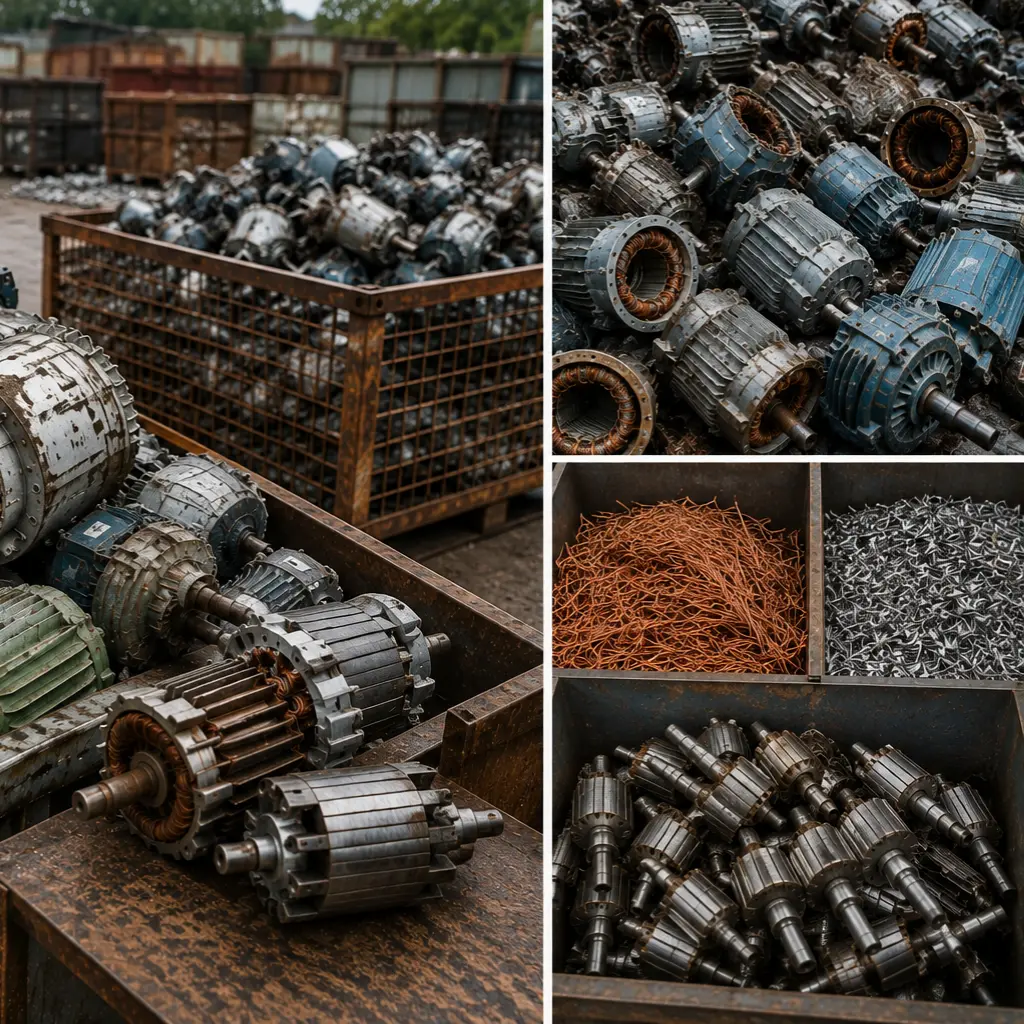
Electric motors are one of the most consistently valuable categories of scrap metal in Melbourne, and one of the most overlooked. Workshops, factories, electricians, HVAC technicians, mechanics, and demolition contractors all accumulate old motors regularly, yet many of them treat these motors as general waste or mixed metal rather than recognising the specific value they carry.
The reason electric motors command strong scrap prices is straightforward. They are not just steel and iron. Inside every electric motor is a winding of copper wire that surrounds a laminated steel core. The copper is the same high-quality conductor used in electrical wiring, and it makes up a meaningful proportion of the motor’s total weight, particularly in larger three-phase industrial motors. When copper prices are strong on the global metals market, electric motors are worth significantly more per kilogram than general steel scrap.
This guide is written for anyone who has electric motors to scrap in Melbourne: mechanics dealing with starter motors and alternators, electricians pulling motors from pumps and fans, industrial maintenance teams managing plant replacements, demolition contractors stripping factories, and HVAC technicians removing old compressor and fan motors from air conditioning systems. We cover what is inside a motor and why it has value, how different motor types compare in scrap terms, what determines the price you receive, whether to strip the copper or sell whole, and exactly how to get the best return at Sky Scrap Metal.
What Is Inside an Electric Motor and Why Does It Have Scrap Value?
To understand why electric motors are worth scrapping carefully rather than throwing in with general steel, you need to understand what they are made of. An electric motor converts electrical energy into mechanical energy through electromagnetic induction. Every component that makes this conversion possible is made from a metal with a specific function, and those metals have different scrap values.
The Copper Windings: The Highest-Value Component
The stator is the stationary part of an electric motor that surrounds the rotating shaft. Inside the stator, copper wire is wound in a specific pattern around the laminated steel core to create the electromagnetic field that drives the rotor. This copper winding wire is typically enamelled copper, also known as magnet wire, coated with a thin insulating varnish that allows the windings to sit close together without short-circuiting.
The copper in the stator windings is the same high-purity copper used in electrical cables and is worth correspondingly high prices at the scrap level. According to the Copper Development Association, copper’s unique combination of electrical conductivity and ductility makes it irreplaceable in motor manufacturing, and the recycled copper from end-of-life motors re-enters production with essentially no loss of quality. This is why scrap dealers and recyclers actively seek electric motors: the copper windings are genuinely valuable material.
In a small single-phase motor of less than 1 kilowatt, the copper winding weight might be a few hundred grams. In a large three-phase industrial motor of 30 kilowatts or more, the stator windings can contain several kilograms of copper. This scaling of copper content with motor size is the main reason that larger motors are worth more per unit.
The Rotor: Steel and Sometimes Copper
The rotor is the rotating component inside the stator. In the most common type of industrial motor, the squirrel cage induction motor, the rotor consists of a laminated steel core with cast aluminium or copper conductor bars running through slots around its circumference, connected at each end by short-circuit rings. In most common squirrel cage motors, the rotor bars are aluminium. In higher-efficiency motors, they may be copper, adding to the motor’s scrap value.
DC motors have a different rotor construction. The DC rotor, called an armature, contains copper windings similar to the stator in an AC motor. DC motors therefore contain more copper overall than equivalent-sized AC induction motors and command slightly stronger scrap pricing.
The Laminated Steel Core: Ferrous Metal Value
The stator and rotor cores are both built from stacks of thin electrical steel laminations, typically 0.35 to 0.65 millimetres thick. These laminations are punched from silicon steel sheet and stacked to form the core. The silicon steel used in motor laminations is a specialist product but at the scrap level it is treated as ferrous metal, contributing to the total weight without adding the premium that copper does.
In small to medium motors, the steel lamination weight often exceeds the copper weight. This is why assessing a motor purely by total weight without accounting for copper content can mislead. The same 10 kilograms of motor material could be 80 per cent steel and 20 per cent copper, or it could be 60 per cent steel and 40 per cent copper depending on the motor type and design, and the scrap value of those two scenarios is quite different.
The Housing: Cast Iron or Aluminium
The outer housing or frame of an electric motor is either cast iron or aluminium depending on the motor’s application and vintage. Older industrial motors, particularly those above 5 kilowatts, typically use cast iron frames because of their rigidity and heat dissipation properties. Many modern motors, particularly smaller ones and those designed for weight-sensitive applications, use aluminium end frames and housings.
Cast iron is a ferrous metal and priced accordingly as scrap. Aluminium housing adds non-ferrous scrap value that is higher per kilogram than cast iron. A motor with an aluminium frame is worth slightly more overall than an equivalent motor with cast iron purely because of the aluminium content.
Bearings and Miscellaneous Components
Electric motors contain steel bearings, steel shaft, and various steel hardware. These contribute to the ferrous metal weight of the unit. Some motors have bronze bearing housings or brass terminal connections that add minor non-ferrous content to the total.
Types of Electric Motors and Their Scrap Value in Melbourne
Not all electric motors are equal in scrap value. The type of motor affects both the total copper content and the ratio of copper to steel, which determines how a recycler assesses it.
|
Motor Type |
Typical Copper Content |
Housing |
Common Sources |
Relative Scrap Value |
|
Three-phase AC induction (large, 15 kW+) |
High |
Cast iron |
Industrial plant, pumps, compressors, conveyor drives |
Highest per unit |
|
Three-phase AC induction (medium, 1-15 kW) |
Moderate |
Cast iron / Al |
Manufacturing equipment, fans, smaller pumps |
Good |
|
Single-phase AC induction |
Moderate |
Aluminium / CI |
Household appliances, small tools, fans |
Moderate |
|
DC motor / armature motor |
Higher for size |
Cast iron / Al |
Older industrial equipment, forklifts, cranes |
Good to high |
|
Submersible pump motor |
Moderate |
Stainless / Al |
Borehole pumps, sump pumps, water supply |
Moderate |
|
Servo motor / stepper motor |
Moderate |
Aluminium |
CNC machinery, robotics, precision equipment |
Moderate |
|
Starter motor (automotive) |
Lower |
Steel / Al |
Vehicles, trucks, plant equipment |
Low to moderate |
|
Alternator / generator |
Moderate |
Aluminium |
Vehicles, standby generators, mobile plant |
Moderate |
|
Universal motor (brush type) |
Moderate |
Steel / Al |
Power tools, vacuum cleaners, kitchen appliances |
Moderate |
|
Compressor motor (hermetic) |
High |
Steel |
Air conditioners, refrigeration, compressors |
Good |
What Determines the Scrap Value of an Electric Motor?
Several factors influence what Sky Scrap Metal will pay for your electric motors. Understanding these gives you realistic expectations and helps you make decisions about how to present your load.
Size and Copper Weight
This is the most significant factor. Motor scrap pricing broadly scales with the weight of copper in the stator windings. Larger motors contain more copper winding wire and are therefore worth more per unit. As a general principle, large three-phase motors from industrial plant are among the most valuable scrap items per unit that a maintenance engineer or electrician is likely to handle.
A rough rule of thumb used in the scrap industry is that the copper winding weight in a standard AC induction motor is approximately 20 to 35 per cent of the total motor weight, depending on the design and efficiency class. Higher-efficiency motors designed to IEC efficiency classes IE2 and IE3 often contain more copper than older motors of the same power rating because more copper winding is one of the ways to improve efficiency.
Current Copper Commodity Price
The scrap price for electric motors is fundamentally linked to the copper price. Copper is traded on the London Metal Exchange (LME) and the price fluctuates daily based on global supply, demand, and market sentiment. When copper prices are elevated, electric motor scrap prices are proportionally higher. When copper prices are suppressed, motor scrap prices follow. Sky Scrap Metal pays current market rates assessed on the day of your transaction.
Whole Motor Versus Stripped Copper
A motor presented whole is assessed at a blended rate that accounts for the copper windings, the steel laminations, and the housing as a combined unit. A motor where the copper windings have been stripped out and presented separately allows the copper to be priced at the copper rate and the remaining steel core and housing at the ferrous rate. In most cases, the total dollar return from a stripped motor is higher than from a whole motor, but the difference needs to justify the labour involved in stripping.
Motor Condition
Condition affects processing time and effort. A clean motor in good mechanical condition with accessible windings is easier to process than one that is seized, full of oil, burnt out, heavily corroded, or encased in epoxy resin potting compound. Heavily contaminated motors may be assessed at a lower rate to account for the additional processing required. However, a non-working motor is not a problem: scrap value comes from the metal content, not the operational status.
Volume
As with most scrap metal categories, larger volumes attract better per-kilogram pricing. A single small motor brought in separately will be assessed at standard rates. A ute load of assorted motors, or a pallet of large industrial motors from a plant strip-out, will typically attract a better commercial rate.
Electric Motor Scrap Prices in Melbourne: What to Expect
Because motor scrap pricing depends primarily on copper content and current copper commodity pricing, it is not possible to give a single fixed price. What we can provide is a clear framework:
|
Motor Category |
Approx. Weight Range |
Estimated Copper Content |
Indicative Value Driver |
|
Small appliance motors (under 0.5 kW) |
0.5 to 3 kg |
Low (15 to 20% of weight) |
Primarily steel value with small copper contribution |
|
Single-phase motors (0.5 to 2 kW) |
3 to 15 kg |
Moderate (20 to 25%) |
Mix of copper and steel, reasonable return in volume |
|
Three-phase motors (2 to 15 kW) |
15 to 80 kg |
Good (25 to 32%) |
Strong copper return, good individual value |
|
Large three-phase motors (15 to 75 kW) |
80 to 400 kg |
High (28 to 35%) |
Significant copper value, among best scrap per unit |
|
Very large industrial motors (75 kW+) |
400 kg to 2+ t |
High (30%+ of large weight) |
Very high total value, warrants individual assessment |
|
Automotive alternators and starters |
3 to 12 kg |
Moderate (20 to 28%) |
Reasonable value, best in volume |
|
Price Disclaimer: Electric motor scrap prices are calculated based on estimated copper content and the current copper spot price as quoted on the London Metal Exchange (LME) copper contract. Copper prices move daily and can be volatile over short periods. The value estimates above are indicative only and are not a quote. Sky Scrap Metal pays current market rates at the time of each transaction. Contact us directly with details of your motors for an accurate assessment. |
Who Has Electric Motors to Scrap in Melbourne?
Electric motors appear in almost every industrial and commercial setting. These are the most common sources of motor scrap in Melbourne:
Industrial and Manufacturing Facilities
Factories and manufacturing plants replace electric motors as part of planned maintenance programmes and equipment upgrades. Drive motors on conveyors, pumps, compressors, fans, mixers, and processing equipment all have finite service lives. A medium-sized manufacturing facility might replace dozens of motors per year. Accumulating these motors before selling them in volume produces better returns. For more information on how Sky Scrap Metal works with Melbourne’s manufacturing sector, see our guide on industrial metal recycling in Melbourne for businesses and factories.
Electricians and Electrical Contractors
Commercial and industrial electricians regularly remove motors from pumps, fans, compressors, and machinery as part of service calls and equipment replacements. The motor comes out as part of the job, and an active commercial electrician can accumulate meaningful volumes over a month. Combining motor scrap with copper cable offcuts and conduit scrap from the same jobs creates a stronger overall load. Our guide on how electricians can turn scrap wire and cable into extra income in Melbourne covers the full picture of the scrap stream available from electrical trade work.
Mechanics and Automotive Workshops
Starter motors, alternators, and power window motors from vehicle servicing are a consistent daily source of electric motor scrap for automotive workshops. These are relatively small and low in individual value, but they accumulate quickly across a busy workshop. A workshop servicing ten to twenty vehicles per day will generate a useful collection of motor scrap every few weeks.
HVAC and Refrigeration Technicians
Air conditioning systems and commercial refrigeration equipment contain fan motors, condenser fan motors, evaporator fan motors, and compressor motors. When units are replaced or fail, these motors come out with the system. Compressor motors in particular are sealed hermetic units that contain meaningful copper content.
Pump Contractors and Plumbers
Water pumps, sump pumps, pressure pumps, and submersible borehole pumps all contain electric motors. Pump contractors replacing end-of-life pump sets generate motor scrap regularly. Submersible pump motors have the added characteristic of being sealed against water ingress, which means they are often in good structural condition even when the pump mechanism has failed.
Demolition and Recycling Contractors
Industrial building strip-outs and demolitions produce electric motors from manufacturing plant, pumping stations, ventilation systems, conveyor systems, and processing equipment. Demolition loads can include motors of all sizes from small single-phase units to large high-voltage industrial drives, and the value of this component of a demolition load can be significant.
Mining and Resources Operations
While Melbourne is not a mining city, regional Victoria and surrounding states have mining and resources operations that send scrap into Melbourne’s recycling network. Mining operations use very large motors in pumping, ventilation, conveyor, and processing applications. These motors, when decommissioned, represent some of the highest-value individual scrap items available.
Should You Strip the Copper Windings or Sell the Motor Whole?
This is one of the most common questions about electric motor scrap and the answer depends on the size of the motor, your available time, and your equipment.
The Case for Selling Whole
When you sell a motor whole, Sky Scrap Metal assesses it as a combined unit: copper windings, steel laminations, and housing are all weighed together and a blended price is applied based on the estimated copper proportion. This is fast, requires no tools or effort on your part, and is the standard approach for most motors.
For small motors, the time required to strip the copper is rarely worth the price difference. A single-phase motor weighing 3 kilograms with perhaps 600 grams of copper winding, the difference in return between selling whole and stripping is modest. Multiplied across a batch of small motors it may add up, but for individual small units, whole is the practical choice.
The Case for Stripping Larger Motors
For larger motors, particularly three-phase motors above 15 kilowatts, the situation changes. The absolute value of the copper winding in a large motor is substantial, and when presented as stripped copper wire rather than as a whole motor, it is priced at the copper wire rate rather than the blended motor rate. The steel lamination core and housing are then sold separately at ferrous rates.
The tools and method for stripping a large motor are straightforward: remove the end caps and bolts, cut or burn the winding connections at the ends, and pull or press the copper coils free from the lamination slots. The resulting stripped copper is a bundle of enamelled copper wire that can be sold at copper pricing.
Whether this is worth your time depends on the motor size, your labour cost, and the current spread between copper and steel pricing. Sky Scrap Metal can advise at the time of your enquiry whether stripping is likely to add meaningful value for your specific motors.
Stripped Copper from Motors Versus Bare Bright Copper
It is important to understand that the copper winding wire from motors is enamelled copper, not bare bright copper. The enamel insulation coating reduces the grade and therefore the price compared to clean bare copper wire. It is still significantly more valuable than steel, but it is not priced at the same rate as clean copper cable stripped of insulation. For more context on how copper grades affect pricing, see our guide on copper wire scrap recycling in Melbourne and getting the best value.
How to Prepare Electric Motors for Scrap
The steps below apply whether you are bringing in one motor or a full trailer load. Good preparation leads to faster assessment and better pricing:
- Remove obvious non-metal components where practical. Plastic terminal boxes, rubber couplings, canvas or rubber mounting pads, and plastic guards add weight without adding scrap value. Removing them takes a minute and keeps your load clean.
- Drain oil from gearbox-mounted motors. Motors coupled to gearboxes often sit in an oil bath. Drain the oil before transport to prevent spillage and avoid the mess that can complicate assessment.
- Sort by approximate size category. If you have a mixed load of small appliance motors and large industrial motors, keeping them in rough size categories helps the assessment move faster. Very small motors and very large motors are assessed differently.
- Keep stripped copper windings separate from whole motors. If you have already stripped some motors and have the copper windings loose, keep these separate so they can be priced at copper rates rather than the blended motor rate.
- Note any motors that contain rare earth magnets. Permanent magnet motors, brushless DC motors, and some servo motors contain rare earth magnets made from neodymium-iron-boron or similar alloys. These have their own scrap value and should be identified separately where possible.
- Do not mix motors with unrelated scrap. Motors assessed as part of a mixed load of unidentified metal will attract more conservative pricing than a clean load of motors assessed on their own merit.
How to Sell Your Electric Motor Scrap at Sky Scrap Metal
Drop-Off at Dandenong
Drop-off is the simplest option for individuals, workshop operators, and tradespeople with a load they can transport. Bring your motors to our Dandenong facility during business hours. We weigh and assess on the spot and pay you the same day. For mixed loads with both whole and stripped motors, we assess each category separately.
Commercial Collection for Large Volumes
For industrial facilities, demolition contractors, and businesses generating regular motor scrap, Sky Scrap Metal offers a collection service. We come to your site, assess and load the motors, and arrange payment. For very large motors or awkwardly positioned equipment, we can bring lifting equipment as needed. Contact us with details of your load including approximate motor sizes and quantities for a pre-collection assessment.
Ongoing Accounts for Maintenance Teams
Facilities that replace motors regularly as part of ongoing maintenance programmes benefit from an ongoing account arrangement with Sky Scrap Metal. Rather than managing each transaction individually, an account allows for regular scheduled collections with consistent pricing and documentation. This suits plant maintenance managers and fleet maintenance operations.
Why Recycling Electric Motors Is Important
Copper mining is one of the most energy-intensive and environmentally significant mining activities globally. The average grade of copper ore mined today is less than one per cent copper by weight, meaning more than 99 per cent of the material extracted from a copper mine is waste rock and tailings. Recovering copper from electric motor windings avoids the mining, crushing, concentrating, smelting, and refining chain entirely.
Recycled copper from motor windings re-enters the manufacturing supply chain as secondary refined copper with essentially the same properties as primary copper. It can be drawn into new winding wire for new motors, used in electrical cable, or directed into any other copper application. The energy saving from using recycled copper compared to primary copper is approximately 85 per cent.
Steel from motor cores and housings is also fully recyclable and re-enters the steel production supply chain through electric arc furnace steelmaking, which uses scrap steel as its primary input. Every motor you bring to Sky Scrap Metal is processed responsibly with all recoverable metals directed to the appropriate recycling stream.
Frequently Asked Questions About Electric Motor Scrap in Melbourne
|
Question |
Answer |
|
How much is an electric motor worth as scrap in Melbourne? |
The value depends on the motor’s size, type, and the current copper commodity price. Small appliance motors might be worth a few dollars each. Large three-phase industrial motors of 30 kilowatts or more can be worth several hundred dollars per unit when copper prices are strong. Contact Sky Scrap Metal with your motor specifications for a current indication. |
|
Do you buy motors whole or do I need to strip the copper first? |
Sky Scrap Metal accepts motors both whole and stripped. Whole motors are assessed at a blended rate that accounts for copper and steel content. Stripped copper windings are priced at the copper wire rate. For large motors, stripping can improve your total return. For small motors, selling whole is usually more practical. |
|
What types of electric motors do you accept? |
We accept all common types of electric motors including AC induction motors, DC motors, servo motors, submersible pump motors, automotive starters, alternators, and compressor motors in any size from small appliance motors to very large industrial units. |
|
Do you accept motors that are burnt out or non-functional? |
Yes. A burnt-out motor still contains the same copper windings and steel core as a working motor. Operational condition does not affect whether we accept the motor or the basis on which we price it. We assess the metal content, not the working status. |
|
Are automotive alternators and starter motors worth bringing in? |
Yes. Alternators and starter motors contain copper windings and are accepted. They are lower in individual value than large industrial motors but accumulate quickly in a busy workshop. Bringing them in as a batch of ten or more makes the trip worthwhile. |
|
Do you offer pick-up for industrial motor loads? |
Yes. For significant volumes from plant strip-outs, maintenance programmes, or demolition jobs, Sky Scrap Metal offers commercial collection. Contact us with details of your motor types and approximate quantities and we will arrange a suitable time. |
|
How is a motor with a gearbox attached priced? |
A combined motor and gearbox unit is assessed as a mixed item. The gearbox adds cast iron, steel gears, and potentially bronze bushings to the overall weight. We can assess the motor and gearbox together or separately. If you have the ability to separate them before bringing them in, separate pricing often produces a better combined return. |
|
What about motors with rare earth magnets? |
Some permanent magnet motors, brushless DC motors, and servo motors contain rare earth magnets made from neodymium-iron-boron or similar materials. These have their own scrap value beyond the copper and steel content. Let us know if your motors contain rare earth magnets and we will assess them accordingly. |
|
Is there a minimum number of motors required for a collection? |
For site collections, we generally require a meaningful volume to justify the trip. For drop-off, there is no minimum: single motors are accepted. If you are unsure whether your volume warrants a collection, contact us and we will give you a direct answer. |
|
How do copper prices affect motor scrap prices in Melbourne? |
Copper is traded daily on the London Metal Exchange and the spot price changes every business day. Because electric motors contain a significant proportion of copper, movements in the copper price directly affect motor scrap pricing. When copper is strong, motor scrap returns are higher. When copper is weaker, motor returns follow. Sky Scrap Metal always pays the current market rate at the time of your transaction. |
|
Can I get a receipt or documentation for the motors I sell? |
Yes. Sky Scrap Metal provides documentation for all commercial transactions including weight and payment records. This is useful for businesses needing to record asset disposals or scrap sales for accounting purposes. |
|
What is the difference between a wound rotor motor and a squirrel cage motor for scrap purposes? |
A squirrel cage induction motor has cast aluminium or copper bars in the rotor, with the main copper content in the stator windings. A wound rotor motor has copper windings in both the stator and rotor, meaning its total copper content is higher for the same frame size. Wound rotor motors are less common but worth more per kilogram at the scrap level because of the higher copper proportion. |
|
Do you accept water-damaged or seized motors? |
Yes. Physical damage, corrosion, or water ingress does not prevent us from accepting a motor. The metal content remains recyclable regardless of the motor’s mechanical condition. Heavily corroded cast iron housing or seized bearings do not affect the copper winding content. |
|
How should I transport large industrial motors safely? |
Large motors should be secured to the transport vehicle to prevent movement. Eye bolts on industrial motors are designed for lifting and should be used with appropriate lifting slings. Do not stand motors on their side unless designed for it. For very large or heavy motors that are difficult to move, contact Sky Scrap Metal about arranging a site collection rather than attempting to transport them yourself. |
|
Can I sell the motor mounting frames and bases along with the motors? |
Yes. Steel motor mounting frames, base plates, and skid assemblies are ferrous metal scrap and accepted. Bring them along with the motors. Concrete or rubber anti-vibration pads should be separated out first. |
Related Reading
Industrial metal recycling in Melbourne for businesses and factories
Copper wire scrap recycling in Melbourne: get the best value
How to prepare scrap metal for recycling in Melbourne and get the best value
Sell Your Electric Motor Scrap at Sky Scrap Metal Today
Sky Scrap Metal buys electric motors of all types and sizes from workshops, factories, electricians, HVAC technicians, mechanics, demolition contractors, and individuals across Melbourne. We are based in Dandenong and offer both drop-off and commercial collection services.
Whether you have a single large three-phase motor from a plant maintenance job, a ute load of assorted motors from a building strip-out, or a regular stream of motors from ongoing maintenance work, contact us to discuss current pricing and the most convenient arrangement. The more detail you can give us about motor types and quantities, the more accurate our upfront assessment will be.