

 Air Conditioner Scrap
 Battery Scrap
 ELECTRICAL MOTORS SCRAP
 ELECTRICAL WIRE SCRAP
 CLEAN LEAD SCRAP METAL
 BRASS SCRAP METAL
 COPPER SCRAP METAL
 STAINLESS STEEL SCRAP
 ALUMINIUM SCRAP
 SCRAP METAL RECYCLING
 SCRAP METAL REMOVAL
 CAR YARDS
 CAR REMOVAL
 VEHICLE DISPOSAL
 MONEY FOR CAR REMOVAL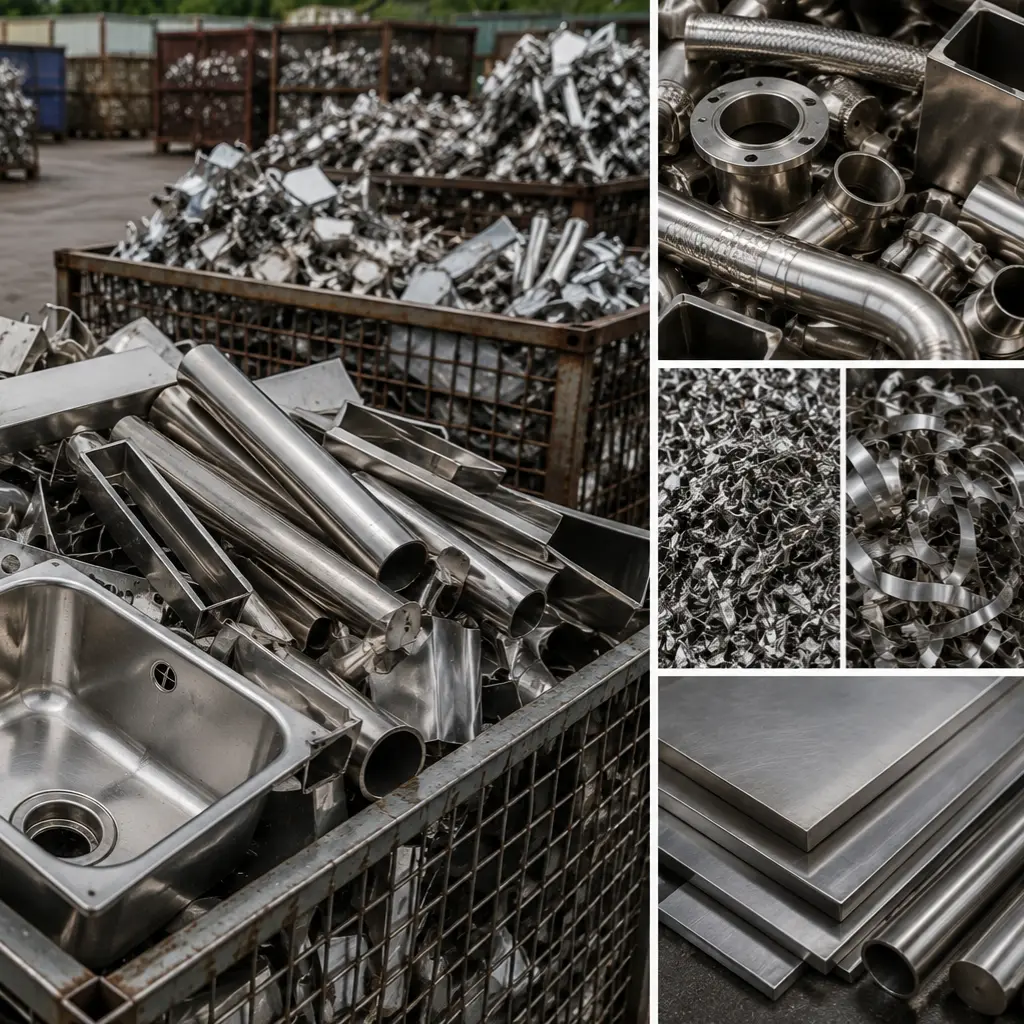
Stainless steel is one of the most widely used metals in Australian commercial and industrial settings, yet it is also one of the most commonly misunderstood when it comes to scrap recycling. Many people who have stainless steel to sell either do not know what grade they have, do not realise the value varies significantly between grades, or end up accepting a lower price than they should because they presented it as mixed or unidentified material.
If you have stainless steel scrap in Melbourne, whether that is from a commercial kitchen strip-out, a manufacturing facility, a construction project, a plumbing job, or a household appliance, this guide covers everything you need to know to get the best return. We explain the grades, what makes each grade more or less valuable, how to identify what you have, where the scrap comes from, and what to expect from Sky Scrap Metal when you bring a load in or arrange a collection.
Stainless steel consistently attracts better pricing than ordinary mild steel because of the alloying elements it contains, primarily nickel and chromium. Understanding this distinction is the first step to ensuring you are not leaving money on the table.
What Makes Stainless Steel Different from Ordinary Steel?
Stainless steel is an iron-based alloy, just like mild steel and carbon steel, but with a crucial difference: it contains a minimum of 10.5 per cent chromium by mass. This chromium content creates a thin, self-repairing oxide layer on the surface that gives stainless steel its characteristic corrosion resistance. Without that layer, ordinary steel rusts and degrades in the presence of moisture and oxygen.
From a scrap recycling perspective, the alloying elements in stainless steel are what make it worth more per kilogram than regular steel. The most important of these is nickel. Many stainless steel grades contain between 8 and 14 per cent nickel, and nickel is a commodity metal with its own separate market pricing. When nickel prices are high on the global metals exchange, stainless steel scrap prices rise accordingly. When nickel prices fall, stainless steel scrap pricing follows.
Molybdenum is another alloying element found in certain grades, particularly Grade 316. Molybdenum improves resistance to chloride corrosion and pitting, which is why 316 is used in marine and chemical processing applications. It also adds value at the scrap level compared to grades that do not contain it.
This relationship between alloy content and scrap value is why identifying your grade before you sell matters. The Nickel Institute notes that over 68 per cent of global nickel production goes into stainless steel manufacturing. The recycled content of stainless steel is already among the highest of any metal, meaning recyclers actively want your stainless steel scrap to re-enter the production cycle.
Stainless Steel Grades: What They Are and Why They Matter for Scrap Pricing
Not all stainless steel is priced equally. The grade determines the alloy composition, and that directly affects what a recycler will pay per kilogram. There are over 150 grades of stainless steel in use globally, but in practice, the vast majority of scrap in Melbourne falls into a handful of common grades.
Grade 304: The Most Common Stainless Steel
Grade 304 is by far the most widely used stainless steel in Australia. It contains approximately 18 per cent chromium and 8 per cent nickel, which is why you will often see it labelled 18/8 on commercial kitchen equipment. Grade 304 is used in food preparation surfaces, sinks, benchtops, handrails, architectural fittings, storage tanks, and countless other commercial and industrial applications.
From a scrap perspective, 304 is the most common grade recyclers receive and it attracts consistent demand. It is non-magnetic or very weakly magnetic in its standard annealed form, which is one of the practical ways to distinguish it from lower-value grades in the field. Grade 304 pricing is the benchmark against which other stainless grades are measured.
Grade 316: Higher Value Due to Molybdenum
Grade 316 contains 16 to 18 per cent chromium, 10 to 14 per cent nickel, and 2 to 3 per cent molybdenum. The molybdenum addition significantly improves resistance to chloride-induced pitting corrosion, making 316 the preferred choice for marine hardware, pharmaceutical processing equipment, chemical tanks, surgical and medical instruments, and coastal architectural applications.
Because 316 contains more nickel than 304 and also contains molybdenum, it commands a premium over 304 at the scrap level. The challenge is that 316 is visually identical to 304. If you have a mixed load of 304 and 316 and cannot separate them, the recycler will price the whole load conservatively. If you know your 316 is 316, presenting it separately is worth doing.
Grade 316L: The Low Carbon Variant
Grade 316L is a low-carbon variant of 316 designed for applications where the steel will be welded. The reduced carbon content prevents sensitisation at weld joints. From a scrap perspective, 316L and 316 are treated as the same grade because their alloy composition is essentially identical for pricing purposes.
Grade 430: Magnetic and Lower Value
Grade 430 contains 16 to 18 per cent chromium but little or no nickel. It is a ferritic rather than austenitic stainless steel, which means it is magnetic. You will find Grade 430 in automotive trim, some kitchen appliance panels, elevator doors, washing machine drums, and decorative architectural fittings.
Because 430 lacks nickel content, it is priced significantly lower than 304 or 316 at the scrap level. The easiest way to identify it in the field is the magnet test. If a bright silver metal is strongly magnetic, it is either 430 stainless, chrome-plated mild steel, or another ferritic grade. If the magnet barely or does not stick, you likely have 304 or 316.
Grade 310: High Temperature Alloy
Grade 310 contains 24 to 26 per cent chromium and 19 to 22 per cent nickel. It is designed for high-temperature applications such as furnace parts, heat treatment equipment, kiln furniture, and combustion chambers. Because of its high nickel content, it commands strong scrap pricing when it appears. It is less commonly seen in general scrap but is worth identifying if you have it.
Duplex Grades Including 2205
Duplex stainless steels such as Grade 2205 contain a mixed microstructure of austenite and ferrite. They typically contain 22 per cent chromium, 5 per cent nickel, and 3 per cent molybdenum. Duplex grades are used in offshore equipment, chemical processing, and high-pressure piping. They are valuable at scrap because of their high alloy content but are relatively uncommon in general commercial scrap streams.
Grade | Chromium % | Nickel % | Other | Common Uses | Scrap Value Relative to 304 |
304 / 304L | 18 | 8 to 10 | None | Kitchens, benchtops, sinks, handrails, tanks | Benchmark |
316 / 316L | 16-18 | 10 to 14 | 2 to 3% Mo | Marine, pharma, medical, chemical, coastal fittings | Higher |
430 | 16-18 | Minimal | None | Appliance panels, auto trim, elevator doors | Lower |
310 | 24-26 | 19 to 22 | None | Furnaces, kilns, heat treatment equipment | Higher |
2205 Duplex | 22 | 5 | 3% Mo | Offshore, chemical processing, high-pressure pipe | Higher |
201 | 16-18 | 3 to 5 | 4 to 6% Mn | Budget kitchen equipment, decorative panels | Lower than 304 |
How to Identify Your Stainless Steel Grade
Identifying what grade of stainless steel you have before bringing it in or arranging collection is one of the most effective ways to maximise your return. Here are the practical methods available to you without specialist equipment.
The Magnet Test
A simple fridge magnet is the fastest first-pass test. Austenitic stainless steels (304, 316, 310) are non-magnetic or very weakly magnetic in their standard form. Ferritic stainless steels (430 and similar) are strongly magnetic. If your sample is bright silver in appearance and the magnet sticks firmly, it is likely Grade 430 or chrome-plated mild steel, not the higher-value austenitic grades. If the magnet slides off or barely holds, you likely have an austenitic grade.
Important caveats: cold working (bending, pressing, welding) can introduce slight magnetism into 304. Some heavily cold-worked 304 may show weak magnetic response. And chrome-plated mild steel can look identical to stainless but is strongly magnetic. Context matters alongside the magnet test.
Stamped or Printed Grade Markings
Commercial kitchen equipment, food processing machinery, medical equipment, and industrial fabrications are often stamped or labelled with the grade. Look for markings such as 304, 316, 18/8, 18/10 (18 per cent chromium, 10 per cent nickel, which is a Grade 304 variant), or SUS304 (the Japanese Industrial Standard designation). These markings are typically found near welds, on equipment nameplates, or on structural members.
Physical Context
The application the steel was used in provides strong circumstantial evidence. Commercial kitchen benchtops and sinks in food service: almost certainly Grade 304. Coastal railing or marine hardware: likely Grade 316. Washing machine drum: likely Grade 430. Surgical trolley or pharmaceutical vessel: likely Grade 316. Older industrial furnace liner: possibly Grade 310. Using context alongside the magnet test narrows down the options significantly.
Professional Testing
For large loads where grade identification is commercially significant, an X-ray fluorescence (XRF) analyser can confirm the exact alloy composition on the spot. Sky Scrap Metal has the equipment to assess grades accurately. If you are bringing in a substantial load and are uncertain of the grade, let us know at the time of booking and we can advise on the most practical assessment approach.
Where Does Stainless Steel Scrap in Melbourne Come From?
Understanding the common sources of stainless steel scrap helps you recognise the value in material that might otherwise be treated as ordinary waste.
Commercial Kitchen Strip-Outs
Melbourne’s hospitality industry is one of the most active sources of Grade 304 stainless steel scrap in the city. Commercial kitchens in restaurants, cafes, hotels, caterers, aged care facilities, and hospitals are fitted almost entirely in stainless steel: benchtops, sinks, shelving, preparation tables, extraction canopies, pass-through windows, bain maries, and refrigeration cabinets. When a hospitality business closes, refits, or relocates, the kitchen strip-out can yield several hundred kilograms of clean 304 stainless. This is among the cleanest and highest-value stainless steel scrap available.
Food and Beverage Processing Equipment
Victoria has a significant food and beverage manufacturing sector. Dairies, breweries, wineries, juice and cordial manufacturers, packaged food producers, and abattoirs all use Grade 304 and Grade 316 stainless steel extensively in their processing vessels, conveyor systems, tanks, piping, and fittings. Equipment upgrades and facility decommissions generate large volumes of high-quality stainless steel, often in identified grades.
Industrial and Manufacturing Offcuts
Stainless steel fabricators and sheet metal workshops generate regular offcuts and off-specification drops as a normal part of production. These offcuts are typically clean, sorted by grade, and represent excellent scrap value because they are uncontaminated and easy to assess. Manufacturing businesses with a regular stainless steel offcut stream benefit from establishing a scheduled collection arrangement.
Construction and Architectural Metalwork
Balustrade systems, handrails, architectural cladding panels, structural fittings, and facade elements in commercial buildings are frequently made from Grade 316 stainless steel for its corrosion resistance and appearance. Demolition contractors and renovation teams stripping out commercial interiors regularly bring in stainless steel from these sources.
Medical, Dental, and Laboratory Equipment
Decommissioned hospital equipment, dental units, laboratory benches, autoclaves, sterilisation equipment, surgical trolleys, and instrument storage are typically Grade 316 stainless steel. These items arrive clean and are often in identifiable grades, making them straightforward to assess accurately.
Plumbing and Mechanical Services
Stainless steel is increasingly used in commercial plumbing for hot and cold water reticulation, particularly in healthcare and food service environments where hygiene standards require it. Stainless steel press-fit pipe, couplings, and fittings from commercial plumbing jobs have genuine scrap value.
Automotive Exhaust and Aftermarket Components
Stainless steel exhaust systems, aftermarket headers, and turbo manifolds from mechanics and automotive workshops represent a consistent stainless steel scrap source. Performance exhaust systems in particular are often fabricated from 304 stainless and can be identified by their characteristic brushed or polished finish.
Marine and Coastal Hardware
The Victorian coastline and boating community generates a supply of Grade 316 stainless steel from cleats, chain plates, rigging hardware, propeller shafts, and deck fittings from vessels being scrapped or refitted.
What Does Stainless Steel Scrap Pay in Melbourne?
Stainless steel scrap is priced per kilogram and the rate fluctuates with the nickel price on the London Metal Exchange. Because nickel is the primary premium element in the most common stainless grades, a movement in nickel pricing directly affects what recyclers pay for stainless steel scrap.
As a practical guide to the relative pricing structure:
Grade | Nickel Content | Mo Content | Relative Price | Notes |
316 / 316L | 10 to 14% | 2 to 3% | Highest among common grades | Premium over 304 due to Mo and higher Ni |
304 / 304L | 8 to 10% | None | Benchmark grade | Most common, most liquid market |
310 | 19 to 22% | None | High when available | Less common, very high Ni content |
2205 Duplex | 5% | 3% | Above 304 | Good value, less commonly traded |
201 | 3 to 5% | None | Below 304 | Mn-substituted for Ni, lower value |
430 | Minimal | None | Lowest among stainless | No Ni premium, closer to mild steel |
Mixed / unidentified | Unknown | Unknown | Discounted | Conservative pricing for uncertainty |
Price Disclaimer: Stainless steel scrap pricing is directly linked to the nickel price as traded on the London Metal Exchange (LME) nickel contract. Nickel prices are volatile and can move significantly within a short period. All prices paid by Sky Scrap Metal are current market rates assessed at the time of transaction and are subject to daily change. The relative pricing structure above is indicative only and does not constitute a quote. Contact Sky Scrap Metal directly for a current price on your specific grade and volume. |
How to Get the Best Price for Your Stainless Steel Scrap
The difference between a well-prepared load and a poorly prepared mixed load can be meaningful in dollar terms. These practices consistently lead to better outcomes:
Sort by Grade Before You Sell
This is the single most impactful thing you can do. A load of clean, identified Grade 316 presented separately from your Grade 304 will earn you more per kilogram on the 316 than if both grades are mixed together. Mixed stainless loads are priced at the lower end of the spectrum to account for the uncertainty. If you know what you have, say so and keep it separate.
Remove Contamination
Stainless steel attached to mild steel frames, welded to carbon steel brackets, encased in rubber gaskets, bolted to plastic fittings, or heavily fouled with scale or coatings will be priced lower than clean stainless. Where practical, remove or separate contaminating materials before bringing a load in. Even partial cleaning that removes the obvious heavy contamination improves your return.
Present It Clean and Dry
Surface contamination with grease, oil, food residue, or chemical residue does not change the grade but it does slow down processing. Clean, dry stainless steel is assessed and processed faster, and for very large loads, cleanliness can influence the offered price.
Accumulate Before Selling
Like most scrap metals, volume improves your per-kilogram rate. If your business generates stainless steel offcuts, scraps, or retired equipment on an ongoing basis, accumulating it before selling, or setting up a regular scheduled collection, will produce better returns than selling a small amount each time.
Know Your Grade and Tell Us
When you contact Sky Scrap Metal, tell us what grade you have if you know it. Providing this information upfront allows us to give you an accurate price before you commit to bringing the load in. If you are unsure of the grade, describe the context and we will give you guidance on what it is likely to be.
How to Sell Stainless Steel Scrap at Sky Scrap Metal
Drop-Off at Our Dandenong Facility
Drop-off is available during business hours and is suitable for individuals, small businesses, tradespeople, and contractors with a load they can transport themselves. Drive in, unload, we weigh and assess, and you are paid on the spot. For loads where grade identification matters, we can inspect and test on arrival.
Commercial Collection
For businesses generating regular stainless steel scrap from manufacturing, food processing, or ongoing maintenance operations, scheduled collection is a more efficient arrangement. Sky Scrap Metal can set up a regular collection schedule that removes the logistics of storing and transporting material from your site. For more information on how industrial and commercial metal collection works, see our guide on industrial metal recycling in Melbourne for businesses and factories.
One-Off Large Volume Collections
For a specific one-off event such as a kitchen strip-out, a facility decommission, or a demolition job where significant stainless steel has been generated, contact us with the estimated volume and grade. We will arrange a collection that suits the timing of your job.
Practical Tips for Sorting and Preparing Your Stainless Steel Load
A few steps taken before presenting your load will make the assessment faster and your return better:
- Use the magnet test to separate likely 304/316 from likely 430. Put them in separate piles and label them accordingly, even informally.
- Remove bolts, brackets, and fittings made from other metals where they can be separated without significant effort. A piece of 316 stainless pipe with cast iron flanges bolted on will be assessed more conservatively than the clean pipe alone.
- Strip rubber seals and gaskets from stainless fittings and flanges where possible. These add nothing to the value and slow down processing.
- Keep offcuts together by grade if you generated them from a fabrication job. If you cut 316L sheet all day, those offcuts are all 316L and should be kept together rather than mixed with anything else.
- Photograph grade markings or equipment nameplates on items you are unsure about. Even a photo of the nameplate on a piece of processing equipment can confirm the grade quickly and save time on arrival.
- Drain and clean vessels and tanks before bringing them in. A stainless steel tank full of chemical residue is handled differently to a clean tank and may attract additional processing considerations.
Why Recycling Stainless Steel Matters
Stainless steel has one of the highest recycling rates of any engineered material globally. The International Stainless Steel Forum reports that over 80 per cent of stainless steel is recycled at end of life. This high recycling rate is partly driven by the value of the alloy and partly by the fact that the nickel and chromium in stainless steel are finite resources that the industry actively wants to recover.
Producing stainless steel from recycled scrap requires significantly less energy than producing it from virgin raw materials. Nickel mining and smelting is an energy-intensive process, and recovering nickel through stainless steel recycling avoids a significant portion of that energy cost. Every kilogram of stainless steel you bring to Sky Scrap Metal re-enters the manufacturing supply chain and reduces the demand for newly extracted nickel and chromium.
Frequently Asked Questions About Stainless Steel Scrap in Melbourne
Question | Answer |
Is stainless steel worth more than mild steel as scrap? | Yes, significantly more in most cases. The nickel and chromium content in stainless steel grades such as 304 and 316 makes them worth considerably more per kilogram than ordinary mild or structural steel. The exact premium depends on current nickel prices. |
How do I know what grade my stainless steel is? | The best starting point is a magnet. Grade 304 and 316 are non-magnetic or very weakly magnetic. Grade 430 is strongly magnetic. Beyond that, look for stamped or printed markings on the equipment. Common markings include 304, 316, 18/8, 18/10, or SUS304. Context also helps: kitchen equipment is almost always 304, marine hardware is usually 316. |
What is the difference between 304 and 316 stainless in terms of scrap value? | Grade 316 contains molybdenum and higher nickel content than 304. Both elements add value at the scrap level. 316 consistently commands a premium over 304, though both are desirable grades with active buyer demand. |
Do you accept mixed or unsorted stainless steel? | Yes. Mixed stainless steel is accepted but is priced more conservatively than sorted, identified loads to account for the uncertainty in grade composition. If you can identify and separate grades, you will receive a better return. |
Can I sell stainless steel with mild steel attached to it? | Yes, but the mild steel contamination affects the pricing. A stainless steel frame with carbon steel legs welded on will be assessed as a mixed load. Removing or separating contaminating metals before you sell will improve your return. |
What is the minimum quantity you accept at drop-off? | There is no minimum quantity for drop-off. You can bring in a single piece if you choose. Pricing per kilogram does improve with volume, but small loads are accepted without restriction. |
Do you offer commercial collection for businesses with regular stainless steel scrap? | Yes. For manufacturers, food processing businesses, and fabricators generating regular stainless steel offcuts or retired equipment, Sky Scrap Metal can arrange a scheduled collection service. Contact us to discuss volume and frequency. |
How do stainless steel scrap prices change over time? | Stainless steel scrap prices are driven primarily by the nickel price on the London Metal Exchange. Nickel can be volatile, with significant price movements occurring within weeks or months in response to supply, demand, and speculative trading. Sky Scrap Metal pays current market rates at the time of each transaction. |
Can I sell stainless steel exhaust systems and automotive parts? | Yes. Stainless steel exhaust systems, aftermarket headers, and turbo manifolds are accepted and priced at current stainless steel scrap rates. These are typically Grade 304. |
Is Grade 430 worth bringing in? | Yes, although Grade 430 is worth less per kilogram than 304 or 316 due to its lack of nickel content, it is still worth more than ordinary steel and is accepted at Sky Scrap Metal. It is best to keep it separate from higher-value grades. |
Can you assess the grade of my stainless steel if I do not know what it is? | Yes. Sky Scrap Metal can assess and identify stainless steel grades on arrival. If you have a significant load where grade identification is commercially important, let us know in advance so we can ensure the right equipment is available. |
Does rust or surface staining affect whether my stainless steel is accepted? | Surface rust staining does not prevent acceptance. Stainless steel can develop surface staining through contact with carbon steel, exposure to chlorides, or environmental conditions. This does not change the grade or the underlying alloy value. It is still accepted and assessed at the appropriate grade price. |
Can I sell stainless steel tanks, vessels, or large fabrications? | Yes. Large stainless steel items such as tanks, mixing vessels, silos, and large fabricated structures are accepted. For items that are too large to transport easily, contact us to discuss a collection or on-site assessment. |
What happens to the stainless steel after you buy it? | Stainless steel scrap purchased by Sky Scrap Metal is processed and sold to steel mills and metal traders who re-melt it to produce new stainless steel. The nickel and chromium are preserved in the recycling process and re-enter the stainless steel production supply chain. |
Can I get a receipt or weight certificate for my load? | Yes. Sky Scrap Metal provides documentation of weight and grade for commercial transactions. This is particularly useful for businesses that need to record scrap sales for accounting or environmental reporting purposes. |
Related Reading
Factors influencing scrap metal prices in Australia: a complete guide
Industrial metal recycling in Melbourne for businesses and factories
How to prepare scrap metal for recycling in Melbourne and get the best value
Sell Your Stainless Steel Scrap at Sky Scrap Metal
Sky Scrap Metal buys all grades of stainless steel scrap from individuals, tradespeople, fabricators, food businesses, and industrial operators across Melbourne. We are based in Dandenong and provide both drop-off and commercial collection services.
Whether you have a single commercial kitchen to strip, a container of manufacturing offcuts to move, or large-format processing equipment to decommission, contact us to discuss current pricing and the most efficient way to get your material in. The more accurately you can describe your grade and volume, the more precise our upfront price indication will be.