

 Air Conditioner Scrap
 Battery Scrap
 ELECTRICAL MOTORS SCRAP
 ELECTRICAL WIRE SCRAP
 CLEAN LEAD SCRAP METAL
 BRASS SCRAP METAL
 COPPER SCRAP METAL
 STAINLESS STEEL SCRAP
 ALUMINIUM SCRAP
 SCRAP METAL RECYCLING
 SCRAP METAL REMOVAL
 CAR YARDS
 CAR REMOVAL
 VEHICLE DISPOSAL
 MONEY FOR CAR REMOVAL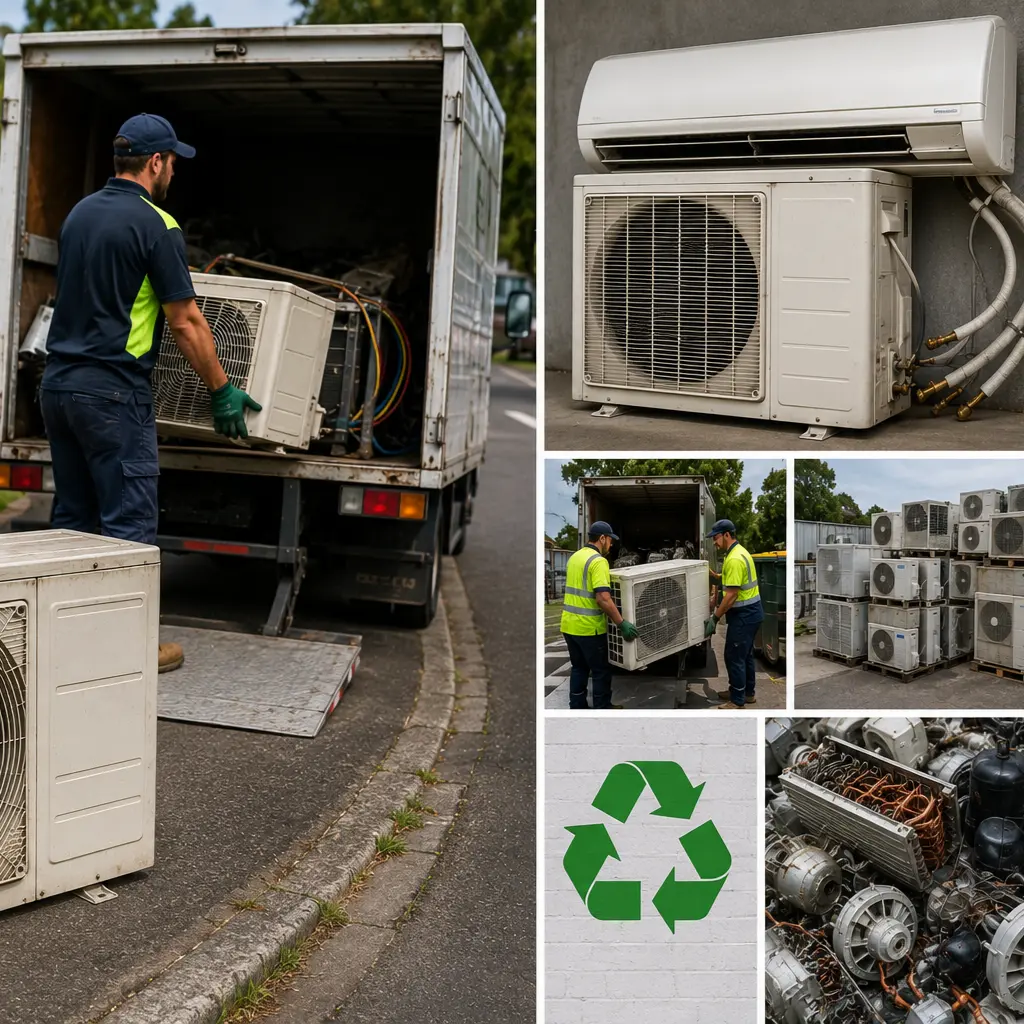
Getting rid of an old air conditioner in Melbourne is one of those tasks that seems simple until you actually try to do it. You cannot put it in the bin. Council hard rubbish collections either refuse them or come with restrictions. Most general rubbish removal companies will take it but charge you a call-out fee and a disposal fee on top of that. And if you have more than one unit, the cost adds up quickly.
The reason people end up frustrated is that they do not realise that an old air conditioner is actually worth money. Not a lot on its own, but enough to change the entire equation. The copper in the refrigerant coils, the aluminium in the heat exchanger fins, and the steel in the outer casing and frame are all recyclable metals with genuine market value. That value is what makes it possible for Sky Scrap Metal to collect your old air conditioner for free and, depending on the size and type of unit, pay you cash for it.
This guide covers everything you need to know about disposing of an old air conditioner in Melbourne the right way. We explain why standard bin disposal is not a legal option, what is actually inside your AC unit and what it is worth, who qualifies for free pick-up, and exactly how the collection process works from first contact to payment. We also cover the rules around refrigerant handling, your obligations as a property owner, and the environmental reasons why proper recycling matters.
Why You Cannot Simply Throw Away an Old Air Conditioner in Melbourne
Most people assume that if a council offers hard rubbish collection, an old air conditioner qualifies. In practice, that is often not the case, and even where councils do accept them, placing a charged AC unit at the kerb without proper handling raises real legal issues. There are two distinct regulatory frameworks that apply.
Refrigerants Are Controlled Under Federal Australian Law
Air conditioners contain refrigerant gases. Depending on the age and type of your system, this could be R-22 (also called Freon, common in systems installed before 2003), R-410A (the most common refrigerant in residential systems installed from the mid-2000s onwards), R-32 (used in many newer, higher-efficiency systems), or R-134a. All of these are classified as either ozone-depleting substances or synthetic greenhouse gases (SGGs) and are regulated under the Ozone Protection and Synthetic Greenhouse Gas Management Act 1989 administered by the Australian Government Department of Climate Change, Energy, the Environment and Water.
The Act makes it an offence to intentionally release refrigerant into the atmosphere. It also restricts who may legally handle refrigerant to technicians holding a current refrigerant handling licence issued by the Australian Refrigeration Council (ARC). An ARC licence is not something a homeowner can hold. Only qualified refrigeration and air conditioning technicians who have completed the relevant training and registration are licensed. This means that when you dispose of an AC unit, the refrigerant inside it must be handled by a licensed professional, either separately before disposal, or as part of the recycling process at a licensed facility.
Sky Scrap Metal’s processing facility manages refrigerant recovery in accordance with ARC requirements. You do not need to arrange separate refrigerant removal before we collect your unit. We handle it correctly at our end.
Air Conditioners Are Banned from Victorian Landfill
Victoria’s e-waste ban, which came into effect on 1 July 2019, prohibits the disposal of electrical and electronic equipment through general waste streams. Air conditioners are explicitly classified as e-waste under the Environment Protection Act 2017 (EPA Victoria) and cannot be placed in household bins, commercial waste skips, or sent to landfill. The ban applies to residents, landlords, and businesses equally.
This is why many Melbourne councils will not accept air conditioners as part of a standard hard rubbish collection. Even those that do have specific requirements around refrigerant decommissioning before the unit can be taken away. The correct disposal pathway is a licensed e-waste recycling facility, which is exactly what Sky Scrap Metal provides.
What Happens If You Dispose of It Incorrectly?
Disposing of an air conditioner through an unlicensed channel, placing it in a skip without proper handling, or leaving it at the kerb with refrigerant intact can attract penalties under both the Ozone Protection Act and Victorian EPA regulations. More practically, any rubbish removal company or council worker who discovers the unit contains refrigerant may refuse to take it or leave it behind. The right approach from the start is to use a scrap metal and recycling service equipped to handle the unit properly.
What Is Actually Inside an Old Air Conditioner?
Understanding what an air conditioner contains is important because it is the reason the unit has value as scrap. Every component of a modern refrigerative air conditioner serves a functional purpose, and most of those components are made from metals that the recycling industry genuinely needs.
The Refrigerant Circuit: Where Most of the Copper Lives
The refrigerant circuit is the heart of any air conditioning system. In a split system, it consists of the indoor evaporator coil, the outdoor condenser coil, the compressor, and the copper tubing that connects them. The coils in both the indoor and outdoor units are made from copper tubing bent into a multi-pass configuration and surrounded by aluminium fins. The interconnecting pipe running between the indoor and outdoor units is also copper, typically insulated with closed-cell foam.
In a larger ducted system, the refrigerant circuit follows the same principles but involves more copper overall. Commercial systems may have significantly more copper in large condenser coils and multi-circuit refrigerant configurations.
This copper is not just any copper. Refrigerant-grade copper tubing is seamless and high-purity, which means it is valuable as scrap. The interconnecting pipe, once stripped of its insulation, is clean copper that commands a strong price per kilogram.
The Heat Exchanger Fins: Where the Aluminium Is
Pressed tightly against the copper coil tubing in both the indoor evaporator and outdoor condenser are hundreds of thin aluminium fins. These fins are designed to maximise heat transfer surface area. They are stamped from thin aluminium sheet and mechanically bonded to the copper tubing. In a typical residential split system, the heat exchanger fin assembly in the outdoor condenser unit alone can contain a meaningful weight of aluminium. Large ducted systems have considerably more.
The Compressor: The Heavy Component
The outdoor unit contains the compressor, which is the electrically driven pump that circulates refrigerant around the system. The compressor housing is typically made from heavy steel, and the compressor itself contains an electric motor with copper windings and steel laminations. The compressor is one of the heaviest individual components in a residential AC system and contributes meaningfully to the total weight of ferrous metal in the unit.
Casing, Frame, and Mounting Hardware
Both the indoor head unit and the outdoor compressor unit have outer casings and internal frames made from steel sheet, typically mild steel or galvanised steel. The outdoor unit in particular has a robust steel chassis designed to withstand outdoor conditions. Wall mounting brackets, outdoor mounting frames, and the associated hardware are all galvanised steel.
Wiring and Electrical Components
The internal wiring connecting the components in both units is copper cable. The main interconnect cable running between the indoor and outdoor units contains copper conductors. Control boards and capacitors have some value in certain circumstances, but the primary electrical scrap value comes from the copper wiring.
Component | Primary Metal | Location in System | Value Contribution |
Refrigerant coil tubing | Copper | Indoor evaporator and outdoor condenser | High |
Interconnecting pipe | Copper | Between indoor and outdoor units | High |
Heat exchanger fins | Aluminium | Both indoor and outdoor units | Moderate |
Compressor housing | Steel / cast iron | Outdoor unit | Low to moderate |
Fan blades and shroud | Aluminium / steel | Outdoor condenser fan assembly | Low to moderate |
Outer casing and frame | Mild / galv. steel | Both indoor and outdoor units | Low |
Mounting brackets | Galvanised steel | Wall and outdoor mounting | Low |
Internal wiring | Copper | Both units | Moderate |
Compressor motor windings | Copper | Inside outdoor compressor unit | Moderate |
How Much Is a Scrap Air Conditioner Worth in Melbourne?
This is the question most people ask first, and the honest answer is that it depends. The scrap value of an air conditioner is not a fixed number. It is a function of the unit’s size, the weight of copper and aluminium it contains, and the commodity market price for those metals at the time of collection. Prices for copper and aluminium change daily on the global commodities market.
What we can say with confidence is that larger units are worth more. A small 1.5 kW window unit has minimal copper and is likely collected for free rather than for cash. A large commercial ducted system has significant copper and aluminium and can attract a meaningful cash payment. The table below gives a general indication.
AC Unit Type | Approx. Capacity | Copper Content | Indicative Value Range |
Small window or wall unit | 1.5 to 2.5 kW | Low | Free collection, minimal cash |
Standard residential split | 2.5 to 5.0 kW | Moderate | Cash payment in most cases |
Large residential split | 5.0 to 9.0 kW | Good | Solid cash return |
Multi-head split system | 8 to 14 kW total | Higher | Good cash return per system |
Residential ducted system | 10 to 16 kW | Significant | Strong cash return |
Commercial ducted or rooftop | 16 kW and above | High | Assessed individually on site |
Price Disclaimer: The indicative value ranges in the table above are based on copper and aluminium commodity pricing as quoted on the London Metal Exchange (LME). Metal commodity prices fluctuate daily and the actual payment you receive will be calculated at current market rates on the day of your collection. The figures above are general guidance only and do not constitute a formal quote. Contact Sky Scrap Metal directly for an accurate estimate based on your specific unit. |
For the latest scrap metal rates across all metals Sky Scrap Metal buys, including copper and aluminium, visit our scrap metal prices in Melbourne 2026 guide.
How Free Air Conditioner Removal in Melbourne Works
The process is genuinely simple and there is nothing complicated required from your end. Here is exactly what happens from first contact to collection:
- Contact Sky Scrap Metal. Call us or submit an enquiry through the website. Give us the details of your units: how many you have, what type they are (split system, ducted, window unit, or commercial), and what suburb you are in. If you are unsure of the type, describe the unit and we will work it out together.
- We provide an upfront assessment. Based on the details you provide, we will give you an honest indication of whether your unit qualifies for a cash payment or free collection before you commit to anything. No surprises on the day.
- We confirm a collection time. We work around your schedule. For residential collections across Melbourne, most bookings are fulfilled within one to three business days. For urgent situations, we will do our best to accommodate a faster turnaround.
- Our team arrives and removes the units. You do not need to dismantle anything or disconnect any piping. Our team handles the full removal. The only thing we ask is that you have isolated the power at the switchboard before we arrive.
- We assess the metal content on the spot. The units are weighed and the copper and aluminium content is assessed. For standard residential units, this is a quick process. For larger commercial systems, the assessment may involve a closer inspection.
- You receive payment. Cash on the day for residential collections where a cash payment applies. Larger commercial volumes may be paid by bank transfer. Either way, you know the amount before we leave.
The entire process costs you nothing. There is no call-out fee, no removal charge, and no hidden administration fee. The scrap metal value inside the unit is what covers the cost of collection.
What Types of Air Conditioners Does Sky Scrap Metal Accept?
We accept all types of residential and commercial air conditioning equipment in any condition, working or non-working. This includes:
- Reverse cycle split systems are the most common type in Australian homes. We accept both the indoor wall-mounted head unit and the outdoor compressor, individually or as a pair.
- Ducted air conditioning systems involve a central indoor unit (usually ceiling-mounted), a network of flexible ductwork, and a large outdoor compressor. We accept the full system or individual components.
- Multi-head split systems where multiple indoor units connect to a single outdoor compressor are accepted as a complete system.
- Window and wall-mounted box units are self-contained and accepted as a single item. These are typically lower in value but still accepted.
- Portable refrigerative air conditioners are accepted, though their scrap value is lower than fixed systems due to smaller coil assemblies.
- Commercial rooftop packaged units contain significant copper and aluminium and are individually assessed. Contact us for large commercial units.
- Evaporative coolers do not use refrigerant but contain aluminium and steel frame components with scrap value. We accept these too.
- Commercial cassette units ceiling-mounted in commercial spaces such as offices, retail, and warehouses, are accepted alongside their outdoor condensers.
Condition does not affect acceptance. A non-functional unit with a failed compressor, a water-damaged unit, or a decades-old system in poor cosmetic condition all still contain the same copper and aluminium. We assess the metals, not the working condition.
Who Uses Sky Scrap Metal for Air Conditioner Disposal?
Homeowners Replacing an Existing System
The most common situation is a homeowner who has just had a new air conditioner installed and needs to get rid of the old one the installer left behind. Sky Scrap Metal makes this easy. Contact us, give us the details, and we arrange collection. No separate tradespeople, no council forms, no rubbish removal fees.
Landlords Managing Multiple Properties
Landlords replacing old AC systems across a rental portfolio often end up with multiple units to dispose of at once. Sky Scrap Metal can co-ordinate a single collection run to pick up units from multiple addresses, which is more efficient than separate trips. For landlords managing strata or apartment complexes, we can work with body corporates on scheduled collections.
HVAC Technicians and Refrigeration Contractors
Licensed HVAC and refrigeration technicians accumulate old units from service and replacement jobs throughout the year. A busy contractor might replace several AC systems per week, building up a significant stock of old units in their yard or workshop. Sky Scrap Metal offers competitive bulk pricing for tradespeople bringing in multiple units at a time. For a full picture of the scrap value available across all components of HVAC work including copper tube offcuts, fan motors, and condenser scrap, see our guide on scrap metal from HVAC and air conditioning work for Melbourne technicians.
Builders and Renovation Contractors
Commercial and residential renovation projects that involve stripping out old HVAC systems generate AC units, ductwork, copper pipe, and condenser units as construction waste. Sky Scrap Metal can collect these alongside other construction metal scrap, making for a single efficient removal job.
Facilities and Property Managers
Commercial property managers overseeing office buildings, industrial facilities, or retail centres that are undergoing fit-out or mechanical refurbishment regularly face the challenge of disposing of multiple commercial AC units at once. We work with facilities managers to plan and execute commercial strip-outs in a way that is cost-effective and compliant.
How to Prepare Your Air Conditioner for Collection
Very little preparation is needed on your part. The following steps will help the collection go smoothly and ensure you receive accurate pricing:
- Turn off the circuit breaker to the AC system. Isolate the power before our team arrives. This is a safety step and allows our team to begin immediately without waiting for electrical isolation.
- Do not attempt to remove refrigerant yourself. Refrigerant handling requires an ARC licence. Attempting to vent or recover refrigerant without a licence is illegal under the Ozone Protection Act. Our facility handles this correctly.
- Keep the indoor and outdoor units together where possible. Together, the indoor evaporator and outdoor condenser give us the most accurate assessment. We accept them separately if one unit is already gone, but the pair gives the clearest picture.
- Include the interconnecting copper pipe if it has been removed. The copper pipe running between the indoor and outdoor units has scrap value on its own. If the installer has already cut it free, include it in the collection. Do not discard it.
- Clear access to both units. If the outdoor compressor is behind a locked gate, on a rooftop, or in a confined space, let us know at the time of booking. We will bring the appropriate equipment or make alternate access arrangements.
- Mention any large commercial units at the time of booking. Commercial rooftop units and large ducted compressors may require specialised lifting equipment. Tell us about large units upfront so we can prepare accordingly.
The Environmental Case for Proper Air Conditioner Recycling
Proper disposal of an old air conditioner is not just a regulatory requirement. It is genuinely good for the environment, and understanding why makes the choice to recycle through a legitimate recycler feel more meaningful.
Refrigerant Gases and Climate Impact
The refrigerant gases used in air conditioning systems are potent greenhouse gases. R-22, which was used in most Australian residential AC systems installed before around 2003, has a global warming potential approximately 1,810 times greater than carbon dioxide over a 100-year period. R-410A, which replaced R-22, has a global warming potential of around 2,088 times CO2. R-32, used in many newer systems, has a lower GWP of around 675 but is still significant. When an AC unit is improperly disposed of and the refrigerant escapes into the atmosphere, the climate impact of that single event is equivalent to releasing many tonnes of CO2.
Energy Savings from Metal Recycling
Recovering the metals from old AC units also avoids significant energy consumption compared to producing the same metals from raw ore. Aluminium production from bauxite is one of the most energy-intensive industrial processes in existence. Recycled aluminium requires approximately 95 per cent less energy to produce than primary aluminium. Copper recycling similarly requires around 85 per cent less energy than smelting copper from raw ore. Every tonne of copper recovered from scrap avoids around 65 gigajoules of energy that would otherwise be needed to extract and refine it from virgin material.
Keeping E-Waste Out of Landfill
Victoria’s e-waste ban was introduced precisely because electronics and appliances sent to landfill leach harmful materials including heavy metals and synthetic compounds into the soil and groundwater over time. Air conditioners that are landfilled intact also waste the valuable materials inside them permanently. Recycling through Sky Scrap Metal means the copper, aluminium, and steel are recovered and re-enter the manufacturing supply chain, reducing the demand for newly mined metal.
Which Melbourne Suburbs Do We Service?
Sky Scrap Metal is based in Dandenong and provides residential and commercial air conditioner removal across Melbourne’s south east corridor and greater Melbourne. Our regular service area includes:
- Dandenong, Dandenong North, Dandenong South
- Keysborough, Springvale, Noble Park, Clayton, Clarinda
- Narre Warren, Narre Warren South, Berwick, Hampton Park
- Cranbourne, Cranbourne North, Cranbourne East, Cranbourne West
- Rowville, Knoxfield, Ferntree Gully, Lysterfield, Scoresby
- Belgrave, Upwey, Tecoma, Monbulk, Selby
- Seaford, Carrum Downs, Skye, Frankston, Langwarrin
- Lynbrook, Lyndhurst, Sandhurst, Botanic Ridge, Clyde
- Doveton, Eumemmerring, Bangholme, Dingley Village
- Mordialloc, Edithvale, Aspendale, Chelsea, Bonbeach
- Wheelers Hill, Mulgrave, Oakleigh South, Huntingdale
If you are in a suburb not listed above but within the greater Melbourne area, contact us and we will confirm whether your address is within our service zone. For customers outside the collection area, drop-off at our Dandenong facility is always available.
Frequently Asked Questions About Air Conditioner Disposal in Melbourne
Question | Answer |
Is air conditioner removal really free? | Yes, the collection itself costs you nothing. There is no call-out fee and no removal charge. The scrap metal value inside the unit, primarily the copper in the refrigerant coils, covers the cost of our collection run. For larger units we can also pay you cash on the day. |
Can I get paid cash for my old air conditioner? | In most cases with a unit of standard residential size or larger, yes. The cash amount depends on the size of the unit and the current copper and aluminium commodity price on the day of collection. Very small units such as old window box units may be collected for free rather than for cash. Contact us with your unit details and we will give you an honest upfront estimate. |
Do I need to have the refrigerant removed before you collect? | No. You do not need to arrange a separate refrigerant recovery job before we arrive. Sky Scrap Metal handles this at our processing facility in accordance with ARC licensing requirements. Simply isolate the power at the switchboard before our team arrives. |
Is it legal to put an AC unit out with the hard rubbish? | Air conditioners are classified as e-waste in Victoria and are banned from landfill under the Environment Protection Act 2017. Many councils do not accept them in hard rubbish collections. Even where a council does accept them, placing a unit at the kerb with refrigerant intact raises issues under the Ozone Protection Act. The compliant and correct approach is to use a licensed recycling service. |
How quickly can you organise a pick-up in Melbourne? | Most residential collections are arranged within one to three business days of your initial contact. We work around your schedule and will always try to accommodate urgent requests. If you need same-day or next-day collection, call us directly and we will advise on availability. |
Do you accept just the outdoor compressor if the indoor unit is already gone? | Yes. We accept the outdoor condenser and compressor unit on its own. It is actually the higher-value component because it contains the larger condenser coil, the compressor motor, and more copper overall. If your indoor head unit has already been removed or discarded, the outdoor unit alone is still worth collecting. |
What if my air conditioner is broken, damaged, or very old? | Condition has no bearing on whether we accept a unit. A completely failed compressor, water damage, physical damage, or a system that is decades old all still contain the same copper, aluminium, and steel. We assess the metals inside, not the operational condition of the appliance. |
Can I drop off rather than arranging a collection? | Yes. You are welcome to bring units to our Dandenong facility during business hours for same-day assessment and payment. If you already have a ute or trailer and want to drop off at your own convenience, this is often the fastest and simplest option. |
Do you collect commercial air conditioners and large rooftop units? | Yes. We collect commercial AC systems of all sizes including rooftop packaged units, commercial cassette systems, and large ducted systems. Large commercial systems require individual assessment and we may need to arrange specific equipment for rooftop access. Contact us in advance with details of the unit and we will plan accordingly. |
How much copper is in a typical residential split system? | The exact copper weight varies by brand, capacity, and age. A standard reverse cycle split system between 2.5 kW and 7 kW contains copper in the refrigerant coils of both the indoor and outdoor units, the interconnecting pipe, and the internal wiring. The coil copper is the dominant component. Larger capacity systems contain proportionally more copper tubing in the condenser coil. |
What happens to the refrigerant in the unit? | At our facility, refrigerant is recovered by ARC-licensed personnel before the unit is broken down for metal recovery. Recovered refrigerant is either reclaimed for reuse or processed through an approved destruction method in accordance with the Ozone Protection Act. It is not released to atmosphere under any circumstances. |
Can I sell the copper interconnecting pipe separately from the unit? | Yes. The copper pipe between the indoor and outdoor units is clean copper with solid scrap value. If it has already been cut and is loose, bring it along with the units. Presenting it separately allows us to price it accurately as copper rather than including it in a mixed-metal assessment. |
Will your team disconnect and remove the indoor wall unit or is that my responsibility? | For standard residential collections, our team handles disconnection and removal of both the indoor and outdoor units. You do not need to arrange a separate electrician or HVAC technician to dismount the units beforehand. For commercial systems with more complex installation configurations, we will discuss the logistics with you at booking. |
Is there a minimum number of units required for free pick-up? | There is no strict minimum. We will collect a single residential unit if it is of sufficient size to justify a collection run. For very small or low-value units where collection may not be practical, we will suggest drop-off as the more sensible option. Contact us with your unit details and we will give you a straight answer. |
Do you service suburbs outside Melbourne’s south east? | Our primary service zone covers Melbourne’s south east, but we regularly service customers across greater Melbourne. Contact us with your suburb and we will confirm whether we can arrange collection. Drop-off at our Dandenong facility is always an option for customers from any Melbourne suburb. |
What do I do with the copper pipe insulation? | The closed-cell foam insulation on the copper interconnecting pipe does not need to be removed before collection. We accept the pipe with insulation intact and process it at our facility. If you want to strip the insulation yourself to present clean copper, that is fine too, but it is not required. |
Can I recycle the remote control, mounting hardware, and accessories along with the unit? | The mounting hardware and brackets are galvanised steel with scrap value and should be included with the collection. Remote controls and plastic accessories do not have scrap metal value and should be disposed of through your council’s e-waste drop-off programme or general e-waste recycling channels. |
Related Reading
- Scrap metal from HVAC and air conditioning work: a complete guide for Melbourne technicians
- What scrap metal is in your old household appliances and what is it worth?
- Scrap metal prices in Melbourne 2026: what are the rates right now?
Get Rid of Your Old Air Conditioner Today
Sky Scrap Metal makes air conditioner disposal simple and cost-free. No call-out fees, no confusing e-waste paperwork, no waiting for a council collection day that may or may not accept your unit. We collect across Melbourne, pay cash where the unit warrants it, and handle the refrigerant correctly so you are not left with a legal or environmental liability.
Call us or submit an enquiry online and we will confirm whether your unit qualifies for cash payment, give you a collection time, and handle everything from there. Whether you have a single old split system from a home upgrade or a dozen commercial units from a building strip-out, we are ready to help.